Showing posts with label U.S.. Show all posts

Friday, November 23, 2012

My Working Paper on Renewable Energy programs and WTO law compatibility


Sharing my Working Paper on "Renewable Energy Programmes in the European Union, Japan and the U.S. - Compatibility with WTO Law" that I completed for the Centre for WTO Studies.

It is also on the Social Science Research Network. The link to that is here.

Comments, critiques and updates most welcome by email.


Tuesday, November 20, 2012

Cloves Cigarettes case - Will the ban be lifted?

A lot has been written about the Cloves Cigarette dispute (DS 406) between the United States and Indonesia which relates to the ban on clove based cigarettes which the WTO found inconsistent with U.S. obligations under the WTO. The Appellate Body ruled against the ban and the U.S. has a "reasonable time" up to July 2013 to comply with the decision. In what manner would the U.S. comply has been a subject matter of intense academic discussion which I have attempted to capture here, here, here and here.

Found this piece titled "Losing Flavor:Indonesia's WTO Complaint against the U.S. Ban on Clove Cigarettes"  in the American University International Law Review, though written prior to the Appellate Body decision, rightly forecasts the decision and offers a four options for the U.S. to follow:

1.It can legislate the ban to apply equally across all flavored-cigarette categories. A blanket ban on all flavored cigarettes would ensure that all flavored cigarettes, regardless of where they were manufactured, would be consistent with the nondiscrimination principles of Article III:4, GATT.

2.It can create other regulatory tools that can potentially realize the policy goal of reducing youth smoking. Such regulations could include any combination of the following policies, as long as the United States implements them consistently across all types of flavored cigarettes: taxation, packaging guidelines, or educational programs.

3. It can treat all flavored cigarettes equally by placing a temporary moratorium on the sale of all flavored cigarettes pending the result of a congressionally mandated scientific study.

4.It  can institute a temporary ban on menthol cigarettes that would “sunset” after the conclusion of the scientific report. After a temporary ban sunsets, Congress can choose to extend or eliminate it entirely.

How would the U.S. comply in this case? Will there be a "political" or "legal" settlement of this dispute? Will negotiations be the way out? Political feasibility, domestic pressure, elections and interpretation of what constitutes "compliance" will determine the course of action. One would have to wait for 2013 for this one to get solved.


Saturday, November 3, 2012

Joseph Stiglitz on trade wars

Joseph Stiglitz writing in the Project Syndicate has shed light on the tension between China and the U.S. on the issue of currency misalignment or manipulation. The U.S. has over the years accused China of deliberately undervaluing its currency in order to boost exports and create a trade surplus. There is a plethora of literature on the issue of currency manipulation and WTO law about which I am not discussing here. Stiglitz's piece titled "No Time for a Trade War" touches upon two aspects that I found relevant: the role of the WTO in curbing the rise of protectionism and the futility of trade wars.
"When the Great Recession began, many worried that protectionism would rear its ugly head. True, G-20 leaders promised that they had learned the lessons of the Great Depression. But 17 of the G-20’s members introduced protectionist measures just months after the first summit in November 2008. The “Buy American” provision in the United States’ stimulus bill got the most attention. Still, protectionism was contained, partly due to the World Trade Organization."
Raising the issue of the futility of a trade war by labeling China as a currency manipulator and risking retaliatory trade measures, he feels that a trade war serves nobody's interests.
"No one wins from a trade war. So America should be wary of igniting one in the midst of an uncertain global recovery – as popular as it might be with politicians whose constituents are justly concerned about high unemployment, and as easy as it is to look for blame elsewhere. Unfortunately, this global crisis was made in America, and America must look inward, not only to revive its economy, but also to prevent a recurrence."
I guess these are points that are quite evident but coming from Stiglitz it definitely requires a mention.

Thursday, October 25, 2012

Labour standards, tomato and trade

As a consumer would you prefer a product from another country made by adopting fair labour standards as compared to one made within the country with unfair labour means? While this is a question of individual conscience, this piece in the National Review raises a similar issue in the context of tomato grown in Mexico and the U.S. While I do not vouch for the veracity of the facts in the piece, it does make a point that international trade at times can be more equitable or justified in certain contexts. 
"Mexican tomato exports to the U.S. have grown rapidly, totaling about $2 billion a year and accounting for half the fresh tomatoes consumed during the winter months; the industry employs some 350,000 Mexicans in Mexico. The Florida farmers have seen their market share shrink and now want the U.S. government to limit the import of Mexican tomatoes.
But not the import of Mexicans. Mexican illegal aliens account for most of the workers in the Florida tomato industry, centered on the town of Immokalee. Worried that the government may get serious about ending illegal employment, the industry has been at the forefront of efforts to import unlimited numbers of foreign workers to slave away in their fields. And I don’t use “slave” to mean the captive form of labor represented by guest-worker programs. I mean actual slaves; there have been numerous slavery prosecutions of Florida tomato growers, whose exploitation of foreign workers is more brazen and appalling than any other industry in the United States."
On the condition of the workers this piece had more detail:
"I've seen estimates that nationally, 70 percent of the low-ranking farm workers are undocumented people from southern Mexico and Central America. These people arrive in this country — they're often shipped here from their home villages — and they arrive in a land where they certainly don't speak English. Many of them don't speak Spanish because they're indigenous so they're more comfortable in these indigenous languages." 
"They're stuck in the middle of the Everglades in some trailer camp. They don't know where they are. They're frightened to go to the police because they're here illegally and also because back home, the police are often thugs and you don't want to go to them anyway. So they're completely vulnerable. They don't want to make any noise — they just want to work, make a bit of money and that leaves them totally vulnerable."
However, there is flip side to this story.What if labour standards are used as a ground to restrict imports of goods? Labour conditions do differ vastly in different countries. Experts argue that the WTO is not the right forum to raise issues of labour standards. It could be used as protectionist tools n the hands of the developed world to restrict imports of products from countries that do not have the same standards as them. Thus while issues of labour conditions, minimum wages, working conditions are critical in the development discourse, linking it to trade may be detrimental to the very workers that it sees to protect.


Tuesday, October 16, 2012

GATS, electronic payments and country commitments

I have blogged about the China Electronic Payment Services case here and here

An ASIL Insight into the China Electronic Payment Services case by Panagiotis Delimatsis provides an overview of the implications of the WTO panel report on interpretation of various provisions of the General Agreement on Trade in Services of the WTO. The panel report as well as the commentary indicate the legal complexity and "country-specific" nature of GATS commitments.I am still very confused about the implications and import of this panel report. Concluding about the implications about the panel report, the author states:
"This case follows landmark decisions on the scope of GATS in US—Gambling and China—Publications and Audiovisual Products and is expected to further open China’s financial services market, benefiting American EPS suppliers in particular. Nevertheless, China will likely have several months to implement the Panel ruling. The Panel decision offered additional clarifications for the interpretation of Members’ Schedules of Specific Commitments under GATS. More importantly, as this case was not appealed, the Panel Report represents the only WTO dispute settlement ruling on the overlap in a Schedule of an  “Unbound” commitment (i.e., no liberalization) and a “None” commitment (i.e., full liberalization). The case confirms that the flexibility attributed to Members in drafting GATS Schedules can be a double-edged sword. At present, no clear solution exists to ensure predictability and security in the interpretation of GATS Schedules."
Unfortunately we will not have the Appellate Body opinion on this case as China has decided not to appeal.

Will require a few more decisions of the WTO panels and Appellate Body on the interpretation of GATS provisions to unravel the Agreement. India's challenge to the U.S. Visa rules perhaps can provide more answers?


Sunday, October 14, 2012

A case for Protectionism? It was always there...

"Protectionism" today is a bad word. In the context of multilateral trade rules, it is forbidden and regressive. Countries publicly eschew protectionist measures, but in practice as is seen, follow them rather regularly. At times, it is argued that developing countries and emerging economies use protectionist tools more than the developed world. Actual study of policies may give a strikingly different picture. Is there a case for "protectionism"? Does history prove us different and surprising lessons?

David Todd in his "Protectionism as Internationalist Liberalism" explores this historical context from 1789-1914 where he argues that Germany, France and the United States have used "protectionist" policies as part of their official policy to counter the rise of U.K. He also puts forth the view that "protectionism" has been part of the larger liberal, internationalist, egalitarian left response to neo-liberalist philosophy since the 18th century and is not something invented in the 1930s.
"From the end of the nineteenth century, especially in Germany, protectionism has thus clearly nourished the xenophobic nationalism that ravaged Europe between 1914 and 1945. But the examples of Thiers, List and Carey show that protectionism was initially the result of intellectual exchanges among “dominated” nations, directed against the dominant power of the British Empire, rather than the expression of a thirst for nationalist domination. These examples also suggest that protectionism was often the economic aspect of an egalitarian liberalism of the left or the centre left, which put the citizen above the consumer. Contrary to the beliefs of many of their respective supporters, in our time as in the nineteenth century, the struggle between free trade and protectionism is not a conflict between good and evil. Tariff barriers do not mechanically lead to war any more than free trade guarantees peace, as is shown by the commercial treaty between France and Prussia in 1862, which did not prevent the outbreak of the Franco-Prussian War in 1870. Tariffs are no more and no less than taxes on imports, which – like all taxes – have both adverse and positive effects on wealth creation. As for their political significance and their economic consequences, these have varied considerably throughout history."
I am not a student of international economic history but this piece raises important questions - is there a good and bad in international trade theory at all or is it a matter of circumstance? Is reduced trade barriers and freer trade , ipso facto, good while "protectionist" measures bad? Do multilateral trade rules stereotype philosophical attitudes of free trade, protectionism and protection of domestic industry? Is there scope within the multilateral trade rules to be reasonably "protectionist"? Perhaps the "Free Traders" would have a far more convincing response to these queries. 


Friday, October 12, 2012

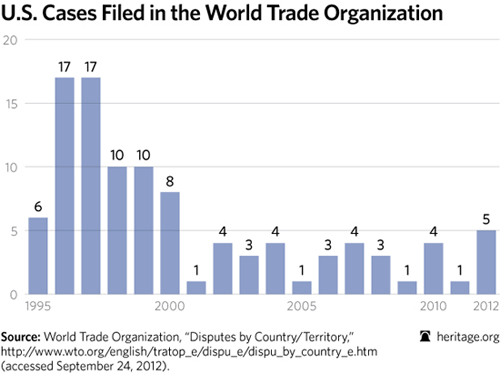
U.S. cases in the WTO decline - A statistic

This graphic shows the WTO cases filed by the U.S. at the Dispute Settlement Mechanism. A substantial decline in cases bright forth from the initial days of the WTO. 

Signs of more political compromise, less trade friction or just circumstances?


Hat tip to The Foundry for highlighting this here in a different context .


Monday, October 8, 2012

Subsidies to Boeing - Has the U.S. complied?

The dispute over U.S. subsidies to Boeing is heating up at the WTO. I had recently blogged about the claim of compliance put forward by the U.S. at the WTO here. A European Union challenge was inevitable. The challenge would have been on both the claim of compliance as well as to what extent the U.S. has complied with the Appellate Body's decision.

The EU challenge is a detailed rebuttal of the U.S. claim of doing away with the subsidies to Boeing. Rejecting the claim of the U.S. that it had complied with the Appellate Body decision in terms of removing the subsidies or removing the adverse effects thereof, the EU has insisted that subsidies continue to be provided by the U.S. to Boeing in violation of the ASCM.

"The actions and events listed by the United States in its 23 September 2012 notification do not withdraw the subsidies or remove their adverse effects, as required by Articles 4.7 and 7.8 of theSCM Agreement. Instead, after the end of the implementation period on 24 September 2012, the United States maintains specific subsidies that cause present adverse effects to EU interests. These subsidies are also prohibited subsidies, as they are contingent on export performance, as well as on the use of domestic over imported goods. Accordingly, in the view of the European Union, the UnitedStates has failed to achieve compliance with the recommendations and rulings of the DSB."
The EU request for consultations on compliance lists out the subsidies allegedly continued to be provided by NASA, Department of Defense, Federal Aviation Administration, Washington State and local subsidies, State of South Carolina. The gist of EU's challenge is here:
"The European Union has carefully reviewed these assertions and measures, and considersthat, after the end of the implementation period, the United States maintains a series of subsidies,within the meaning of Article 1.1 of the SCM Agreement. Those subsidies are specific, within themeaning of Articles 1.2 and 2 of the SCM Agreement. Those specific subsidies presently benefit thedevelopment, production and sale of Boeing's 737NG, 737 Max, 747, 767, 777 and 787 families ofLCA, as well as any other future derivatives of these LCA families, including of the 777.Collectively, and under the conditions of competition present in the LCA markets, those subsidies cause present adverse effects, or threat thereof, to EU interests, inconsistently with Articles 5(c), 6.3(a), 6.3(b) and 6.3(c), including Articles 6.4 and 6.5, of the SCM Agreement. The effects of those subsidies adversely impact sales, market shares and prices of Airbus' A320, A320neo, A330, A350XWB and A380 families of LCA. Specifically, the subsidies cause present serious prejudice, or threat thereof, to EU interests, in the form of: (i) displacement and impedance of EU imports into the United States, within the meaning of Article 6.3(a) of the SCM Agreement; (ii) displacement and impedance of EU exports to other third country markets, within the meaning of Article 6.3(b) of the SCM Agreement (including on the basis of Article 6.4 of the SCM Agreement); and, (iii) significant price undercutting, price suppression, price depression, and lost sales, within the meaning of Article 6.3(c) of the SCM Agreement (including on the basis of Article 6.5 of the SCM Agreement)."
The EU challenge brings to the fore the complexity of the multilateral legal system. What constitutes a subsidy? When does it cause an adverse affect? What constitutes compliance? It also indicates that a dspute is not over even after the Appellate Body has pronounced its decision. In high profile cases, the battleground shifts to issues of compliance and whether circumstances exist wherein adverse affects have been removed.

The EU has also sought countermeasures for the continued non-compliance by the U.S. of the Appellate Body decision:

         " Accordingly, the European Union's countermeasures would consist of one or more of the following:
(1) suspension of tariff concessions and other related obligations under the General
Agreement on Tariffs and Trade 1994 on a list of US products to be established indue course;(2) suspension of concessions and other obligations under the SCM Agreement; and,(3) under the General Agreement on Trade in Services, suspension of horizontal orsectoral commitments contained in the consolidated EU Schedule of SpecificCommitments, as supplemented to incorporate the individual Schedules of SpecificCommitments of its Member States, with regard to all principal sectors identified inthe Services Sectoral Classification List."

Are we going to see any political settlement to this dispute? A plurilateral civil aircraft manufacturing agreement with the U.S., EU, China and Brazil as parties? The Airbus Boeing dispute offer many lessons for WTO watchers - the complexity of dispute settlement, the jurisprudence of subsidies under the ASCM, the long winding dispute settlement proceedings as well as the importance of domestic interests in international trade disputes. We still haven't heard the last of the Airbus dispute. I know books have been written about this dispute - it never ceases to fascinate me.


Saturday, October 6, 2012

Imports good after all?

Protectionism is the buzzword everywhere.With the Doha impasse and severe economic crisis gripping major economies, trends of countries puling themselves towards inward looking policies is noticed. Though lofty declarations in multilateral fora about bringing down protectionist wall and encouraging free trade is often espoused, actions are often diametrically the opposite. National policies aim to strengthen local manufacturing, exports and restrict imports.I have blogged about this trend here and here.

Today's blogpost is contrary to this trend. I found a piece that projects a different picture about free trade, imports and national interest.

Trade Freedom:How Imports Support U.S. Jobs: This American Heritage piece questions conventional wisdom that imports are necessarily bad. Highlighting the benefits of imports in terms of employment and national competitiveness it prescribes a national policy that recognizes that imports supports domestic jobs.While there is an obvious co-relation between exports and local job creation, the study finds that imports, contrary to popular wisdom also has a positive impact on local jobs.


Analyzing the gains to the Apparel industry int he U.S. from imports, the piece argues that a more rigorous analysis of the data related to imports and jobs need to be done to actually understand the co-relation between imports and jobs. It would be naive and factually incorrect to assume that increased imports lead to an increase in domestic job loss. Interesting argument considering that imports from China into the U.S. is a constant source of tension not the issue of U.S. unemployment.
"In a political environment where trade and job creation are being hotly debated, it is vital to have a correct understanding of how imports truly affect jobs. The reality is that the increased economic activity associated with every stage of the import process helps support American jobs. A lot of them. The following analysis shows that over half a million American jobs are supported by imports of Chinese-made clothes and toys alone. These jobs are in fields such as transportation, wholesale, retail, construction, and finance, and in myriad other activities that are involved in turning a manufactured product into a good that is ready for use by the average American."
Can there be a case that imports actually protect jobs domestically? While it is obvious that it leads to loss of jobs in certain activities since the production has shifted to tother countries, does it not lead to job creation in other allied activities? Is the value of job creation in other activities less, equal or much more than the job loss in the activity undertaken outside? Has there been any analysis on this data? Added to this is the complexity global value chains bring to the table. A product is "produced" in so many countries that imports become essential for completion of the product. This piece Is Unilateral Free Trade a Good Thing? the related debates argue in the context of solar subsidies in China and the U.S.argue that unilateral free trade might be beneficial in the long run.

Ofcourse, domestic policy is still far away from recognizing the positive impact imports can have on job creation. Democratic politics, domestic constituencies and the belief that strengthening local production capabilities make imports an easy target. 


Wednesday, September 26, 2012

Compliance time in the Airbus-Boeing dispute?

The Airbus-Boeing subsidies for large civil aircrafts dispute is a longstanding one. With the Appellate Body of the WTO giving its decision in both cases and coming to the conclusion that large subsidies were given by the U.S. and the EU in case of Boeing and Airbus respectively the stage is now set for a prolonged wrangling over what constitutes compliance. I have blogged about the issue here, here and here.

In a USTR press release, the United States submitted indicated it had complied with the Appellate Body decision. The submission made to the WTO is here. The submission showed that NASA, U.S. Department of Defence, Federal Government, State of Washington and City of Wichita were the stakeholders in the complex quagmire of subsidy disbursement.

The highlights of the claims of compliance were:
"3. The National Aeronautics and Space Administration (“NASA”) has modified the rights accorded to the parties under the contracts listed in Annex A so as to make them consistent with commercial practice. These modifications apply to all of the NASA contracts covered by the recommendations and rulings of the DSB. NASA has made identical modifications, as necessary, with regard to contracts subsequent to those covered by the recommendations and rulings of the DSB, without prejudice to the U.S. view that those contracts were not subsidies causing adverse effects to EU interests. These contracts are also listed in Annex A. 
4. NASA has terminated the Advanced Composites Technology, High Speed Research, Advanced Subsonic Technology, High Performance Computing and Communications, Quiet Aircraft Technology, Vehicle Systems, and Research and Technology Base programs, and reduced funding for aeronautics research contracts with private parties under other aeronautics research programs. NASA has changed its policies so as to remove limitations on access to the results of NASA research and development efforts, including by ceasing the use of limited exclusive data rights (“LERD”) clauses. NASA has implemented a policy of seeking greater prompt disclosure of the results of its sponsored research when it purchases research and development services from private entities. 
5. The U.S. Department of Defense (“DoD”) has modified the rights accorded to the parties under the cooperative agreements, technology investment agreements, and Other Transactions listed in Annex B so as to make them consistent with commercial practice. The modifications apply to all of the DoD assistance instruments covered by the recommendations and rulings of the DSB. DoD made identical modifications with regard to contracts subsequent to those covered by the recommendations and rulings of the DSB, without prejudice to the U.S. view that those contracts were not subsidies causing adverse effects to EU interests. These contracts are also listed in Annex B. 
6. DoD has ceased funding of the following programs: Dual Use Application and Dual Use Science and Technology (Program Element (“PE”) 0602305F); Navy Manufacturing Technology (“ManTech”) (PE 0603771F); Air Force ManTech (PE 0708011F); Defense Advanced Research Projects Agency research on the Joint Strike Fighter (PE 0603800E); Army research related to the Comanche (PE 0604223A); Air Force research on the B-2 (PE 0604240F); and Air Force research on A-6 Squadrons (PE 0604240F). 
7. The United States enacted legislation terminating the Foreign Sales Corporation and Extraterritorial Income (“FSC/ETI”) tax benefits. 
8. The United States has confirmed that Boeing did not use FSC or ETI tax benefits after 2006. 
9. The State of Washington is applying rates of Business and Occupancy Tax (“B&O”) for aerospace manufacturing and retailing consistent with Article 5(c) of the SCM Agreement. 
10. The City of Wichita is applying its Industrial Revenue Bond (“IRB”) program in a manner consistent with Article 5(c) of the SCM Agreement. It has not provided any IRBs to Boeing since 2007." 
The compliance report indicates either a modification or a cessation of many programs hitherto being implemented by NASA, DoD, the Federal Government as well as the State of Washington. While the opinion whether this actually constitutes compliance or is sufficient to determine that a “genuine and substantial relationship of cause and effect” no longer exists between the subsidies subject to the recommendations and rulings of the DSB and any adverse effects within the meaning of Article 5(c) of the SCM Agreement is a matter of interpretation, this is a classic example of domestic measures being impacted by global trade rules. National policies being implemented by various agencies in the context of U.S. Aircraft manufacturing needed to be modified in order to comply with a WTO decision. Whether this is a sufficient modification or compliance to the WTO decision is a different issue. The EU would certainly dispute the claim of compliance unless there already has been an understanding on this diplomatically and politically.

Over to the EU to provide its list of compliance measures with respect to Airbus subsidies?


Update: The EU HAS disputed the claim of compliance by the U.S. More on that for tomorrow!

Saturday, August 25, 2012

U.S. takes on Argentina now - Import licensing procedures challenged

This was expected for some time. The U.S. finally initiated a dispute against Argentina by requesting for consultations for what it called "restrictive import licensing procedures" that violate Argentina's commitments at the WTO. I have earlier blogged about Argentina's measures here, here and here. The E.U. and Japan are the other members that have also taken Argentina to the DSM. Reports of Argentina striking back with a complaint against Spain's biofuel policy is reported here. MoneyBox has a succinct analysis of the "tit for tat" policy surrounding some of these trade measures which typifies a "protectionist" trend necessitated by domestic compulsions.

The gist of the US request is reproduced below:

"Argentina often requires the importers of goods to undertake certain commitments, including, inter alia, to limit their imports, to balance them with exports, to make or increase their investment in production facilities in Argentina, to increase the local content of products manufactured in Argentina (and thereby discriminate against imported products), to refrain from transferring revenue or other funds abroad and/or to control the price of imported goods. 
The issuance of CIs and the approval of DJAIs are being systematically delayed or refused by the Argentinean authorities on non-transparent grounds. The Argentinean authorities often make the issuance of CIs and the approval of DJAIs conditional upon the importers undertaking to comply with the above-mentioned trade-restrictive commitments. 
These measures restrict imports of goods and discriminate between imported and domestic goods. They do not appear to be related to the implementation of any measure justified under the WTO Agreement, but instead appear to be aimed at advancing Argentina's stated policies of re-industrialization, import substitution and elimination of trade balance deficits. 
... 
Argentina's measures appear to be inconsistent with Argentina's obligations under the following provisions of the covered agreements: 
(i)  Articles III:4, X:1, X:2, X:3(a) and XI:1 of the GATT 1994; 
(ii)  Article 2 of the TRIMs Agreement; 
(iii)  Articles 1.2, 1.3, 1.4, 3.2, 3.3, 3.4, 3.5, 5.1, 5.2, 5.3 and 5.4 of the Import Licensing Agreement; and 
(iv)  Article 11 of the Safeguards Agreement." 
The USTR officially announced this request for consultation here. This also seems to be one of the first disputes wherein the new agency created for trade violation enforcement in the U.S. - The Interagency Trade Enforcement Center - seems to have played a role. I had earlier blogged about setting up of this agency here. 

The Center has been established within the USTR itself and is headed by an Assistant USTR named as the Director of the Center. The setting up of the Interagency Trade Enforcement Center with representatives from Agriculture,Homeland Security, Justice, State, Treasury and the Intelligence Community is a good example of interdepartmental co-ordination to take on trade disputes with other WTO members. Most of the times WTO disputes are not the preserve of the Ministry dealings with Commerce alone. It has an impact on the jurisdiction of other departments as well and is usually concerned with areas concerning other departments. An agency that can co-ordinate this effort with a strong team of law experts, trade analysts and researchers, is perhaps, what is required for effective engagements within the WTO. Can this Center be a model for other countries, albeit with local modifications, to engage with the multilateral system?


Friday, August 3, 2012

Of Rum and a WTO dispute


Rum and a WTO dispute? This looks plausible with the Caribbean countries raising the issue of "subsidization" of the rum industry in the U.S. The issue was widely reported here, here and here. The Caribbean countries are the 13 island countries in the Caribbean sea which includes Antigua, Dominican Republic and Haiti.


Caribbean Map, Caribbean Islands, Map of the Caribbean, West Indies Map

The Caribbean countries produce and export rum in large quantities to the U.S. and EU. The issue essentially pertains to the "cover-over" program wherein the U.S. provides refunds of excise tax collected on rum to the U.S. States producing it. A brief history of the cover-over program is provided by this Congress Research Service Report

Apart from the Caribbean countries, Puerto Rico (PR) and U.S. Virgin Islands (USVI) also produce rum which serves as competition to the rum produced in the Caribbean countries. The funds received by PR and USVI  in turn is being allegedly used to develop the rum industry and infrastructure in these U.S. States that adversely impacts rum producers in the non-US Caribbean countries. The  U.S. transfers 98% of the revenues collected on excise taxes imposed on rum sold in the US market to the Governments of Puerto Rico and the USVI. The programme does not provide any limitation as to how these two territories are to spend the transferred revenues. Until 2008, these funds were used for infrastructural development and welfare programmes by the Governments of the two territories. However, both territories are now said to be using some of these funds to finance activities aimed at the promotion and assistance of the local rum industry, to the detriment of rum producers established in these countries. 


The issue of the use of the funds for assisting the local rum industry has to be critically analyzed in the context of U.S. obligations under the ASCM Agreement. While use of the funds for general infrastructural development may be out of the purview of a WTO law  inconsistency, specific programs to promote and develop the rum industry may be suspect. Would it amount to a prohibited or actionable subsidy under ASCM? Would it violate the NT and MFN principles under GATT?

Cato explains the dispute lucidly here:
"The antagonist in this saga is something known as the “rum cover-over” program. As it does with all distilled spirits, the federal government charges an excise tax of $13.50 per proof gallon of rum sold in the United States. This equates to roughly $2 per bottle. Under the cover-over program, almost all of that money is directly granted to the U.S. Virgin Islands and the Commonwealth of Puerto Rico using a complex formula so that each receives a share of the money based on how much rum it produces relative to the other. The tax is collected from sales of all rum imported to the mainland, even from other countries, and in 2010 the cover-over amounted to approximately $450 million—$100 million to the Virgin Islands and $350 million to Puerto Rico. 
The industrial death spiral began when the government of the U.S. Virgin Islands cleverly discovered that, instead of using the money for infrastructure and welfare programs, it could use the bulk of the money to entice Captain Morgan producer Diageo to relocate there from Puerto Rico. Because the move will increase rum production in the U.S. Virgin Islands relative to Puerto Rico, the subsidy more than pays for itself by it helping the territory capture a larger share of cover-over funds."
Is the refund of excise taxes by the U.S. to PR and USVI and their subsequent use to promote the local rum industry in violation of U.S. obligations under the ASCM and GATT? The measures seem to have an adverse impact on the rum producers of other Caribbean countries and thus, as observers believe, amount to an actionable subsidy under WTO law. Will the Caribbean rum producing countries initiate a WTO dispute against the U.S.? Dominican republic, which has joined the Tobacco Plain Packaging dispute against Australia is likely to initiate this dispute against the U.S.

(Local Caribbean sugarcane growers)

The impact the U.S. measure has on local, small time producers of rum in the Caribbean countries is brought out by this commentary:
"While there is understanding of the economic problems facing the USVI, the reality is that the US Congress has allowed its USVI development program to divert hundreds of millions to primarily provide a development program for the largest distilled spirits companies in the world.  In this way the US is damaging one of the few competitive industries that Cariforum nations have and which helps underpin the economic viability of small and sometimes vulnerable Caribbean states.
... 
Rum has a special place in the hearts and minds of Caribbean people. It is a product that brings identity through small producers to the islands and countries of Cariforum from which it comes.  Unlike the product of large multinational distilling groups the success of Cariforum producers does not result from artificial tax breaks, transfer pricing or subsidy. Instead it is an industry dominated by small local distillers whose product is export oriented, brings much needed foreign exchange, adds value to primary agriculture and provides significant levels of tax and revenue to Governments struggling to deliver social programmes. 
That is why rum has always been a product worth fighting for, as Europe knows to its cost and the US is about to discover."
Will the Rum dispute go all the way to the WTO? 


Monday, July 30, 2012

To comply or not to comply - Dolphin safe labeling in the U.S.

The Dolphin Safe Tuna case at the WTO has generated considerable debate and discussion in terms of the interpretation of the TBT Agreement as well as the next steps related to compliance for the U.S. The WTO Appellate Body had ruled against the labeling scheme as being inconsistent wit Article 2.1 of the TBT Agreement since it treated Mexican tuna products less favorably than U.S. tuna products. The case also raises the issue of the right forum for the dispute since NAFTA mandates the disputes of such a nature to be brought before it's adjudicatory process.  I have blogged about the case here, here and here.

ASIL Insights has a piece recently that highlights the importance of the case for WTO jurisprudence. Elizabeth Trujillo in her piece titled "The WTO Appellate Body Knocks Down U.S. “Dolphin-Safe” Tuna Labels But Leaves a Crack for PPMs" explains in great detail the interpretation of various provisions of the TBT Agreement and its impact on non-product related process and production measures (PPMs).
"US—Tuna II is a landmark case for the trade and environment relationship and, more specifically, for the future adjudication of technical regulations under the TBT Agreement. In finding the U.S. labeling scheme inconsistent with TBT Article 2.1, the Appellate Body effectively characterized a measure based on non–product–related PPMs as a discriminatory technical regulation. However, the case leaves open the applicability of the TBT Agreement to PPM-based regulations in general—a controversial issue especially for developing nations because of the effect such regulations may have on market access of their products."
I am not going into the details of the AB report here as this has already been done. the focus of this post is an interesting reference to views in the U.S. not to comply with this decision. Eyes on Trade has referred to them here. A letter from a few U.S. Senators has urged the U.S. Administration not to abandon the labeling scheme:
"We are deeply disappointed by the WTO's final ruling, but we stand firmly committed to the Dolphin-Safe label. Let us be clear - Congress has no intention of repaying or weakening the current law applying to this label. Therefore, we request your assistance in developing a solution of complying with the ruling that maintains the current level of protection for dolphins."
Can the U.S. "develop a solution" that both complies with the WTO ruling as well as does not change the labeling scheme? Would extending the same certification standards and regulatory strictness to non-Eastern Tropical Pacific (ETP) regions be sufficient to ensure compliance?

The issue of compliance in WTO law is a complex one. What constitutes compliance in the present case. Striking down the labeling scheme would be one way to comply with the ruling. But would it be the only way? Are there other innovative ways to comply with the ruling, yet maintaining the same labeling scheme? This once again brings out the fact that a country can creatively engage with the WTO system to protect one's perceived national interest. How the U.S. would comply in this case is a matter of conjecture at this stage. Domestic interests and compulsions would probably shape the nature and form of U.S. compliance in this case.


The more important point is that even after a WTO ruling has been given there is debate internally in the country as to whether there should be compliance. In other words, the options before a member in a WTO dispute does not end with the WTO ruling. With strategic lawyering and creative interpretations, one may still continue with the old measure but remain in compliance. This, however, also raises issues about the efficacy of the WTO DSM which is based on a rule based system and an adjudicatory process hat ensures compliance or retaliation. It is one thing not to comply and face retaliation as per the DSU, but quite an other thing to continue with the measure that was held to be violative but to claim compliance.

Interesting times for WTO jurisprudence.


Thursday, July 19, 2012

China, electronic payments and WTO - Who won?

The WTO Dispute Settlement Mechanism's first forays into the financial payments sector were made with a Panel report on the electronic card system of China in relation to China's GATS obligations. It was widely reported here and here.The U.S. had challenged certain aspects of the electronic card payment system of China at the WTO. The Panel Report was out on the WTO website.

The Panel seemed to have ruled in the favour of the U.S. In a detailed over 100 page Report the WTO Panel has discussed in detail the nature of payment transactions, General Agreement on Trade in Services (GATS) obligations in relation to electronic payment systems, China's specific obligations under GATS and the violation of GATS obligations of market access and national treatment by China in this regard.This Panel report also is one of the few reports that discusses in detail the interpretation of certain provisions of the GATS.

The main U.S. challenge is found in para 7.208 of the Panel report:

"7.208 The United States has identified a series of six requirements, or measures, which it claims operate alone or in combination to impose market access restrictions and national treatment limitations on service suppliers of other WTO Members seeking to supply EPS in China.  The United States argues that these measures are maintained through a series of legal instruments.  As will be discussed in detail in Sections VII.F and VII.G, the United States asserts that these six requirements are inconsistent with China's obligations under Articles XVI:1 and XVI:2(a), and Article XVII of the GATS.
7.209    The United States has alleged the existence of the following requirements
(a)        Requirements that mandate the use of CUP and/or establish CUP as the sole supplier of EPS for all domestic transactions denominated and paid in Renminbi (RMB) (hereafter referred to by the Panel as "sole supplier requirements");
(b)        Requirements on issuers that payment cards issued in China bear the CUP logo ("issuer requirements");

(c)          Requirements that all ATMs, merchant card processing equipment and POS terminals in China accept CUP cards ("terminal equipment requirements"); 

(d)         Requirements on acquiring institutions to post the CUP logo and be capable of accepting all payment cards bearing the CUP logo ("acquirer requirements");
(e)      Prohibitions on the use of non-CUP cards for cross-region or inter-bank transactions ("cross-region/inter-bank prohibitions"); and
(f)        Requirements pertaining to card-based electronic transactions in China, Macao, and Hong Kong ("Hong Kong/Macao requirements")

7.210     The United States considers that these requirements are maintained through a series of Chinese legal instruments that are themselves identified in the United States' request for establishment of a panel."
The Panel Report contains a detailed analysis of China's financial payment sector, it's GATS obligations and the contravention of GATS obligations. Rejecting many of the U.S.arguments that China's measures were inconsistent with GATS obligations (pertaining to monopoly and market access) the Panel concluded that China maintains a requirement that all payment cards issued in China must bear the “Yin Lian”/“UnionPay” logo and be interoperable with that network, a requirement that all terminal equipment in China must be capable of accepting “Yin Lian”/“UnionPay” logo cards, and finally, a requirement that acquiring institutions post the “Yin Lian”/“UnionPay” logo and be capable of accepting all payment cards bearing the “Yin Lian”/“UnionPay” logo.  The panel found each of these requirements to be inconsistent with China's mode 1 and mode 3 national treatment obligations under Article XVII of the GATS.  It found, through these requirements, that China modifies the conditions of competition in favour of CUP and therefore fails to provide national treatment to EPS suppliers of other Members, contrary to China's commitments.

The Report itself requires a number of readings since it dwells into the details of China's financial payment system regulations as well as GATS obligations. I will leave that to the experts. This blogpost does not attempt to decipher the decision. That requires far more expertise and analysis.

Some initial thoughts on the Panel Report, though:

1. This Report is another classic case of threadbare analysis of the trade/service (electronic payment system, in this case) and applying legal principles enshrined in the multilateral rules to business realities. It reinforces the point I often make of multidisciplinary teams required to represent a country's interests - in this case, ideally, the team representing both countries should have consisted (I am sure they would have) of trade lawyers, economists, financial sector experts, financial payment system experts, technologists and the government's trade policy specialist. The expertise required is so multidisciplinary that it must involve a combined effort. Just as negotiating teams should be multidisciplinary, teams working on the dispute resolution side should also be multidisciplinary.

2. The Panel responding to a claim of the U.S. regarding establishing the monopoly status of China's agency, signified the importance of economic data and evidence in Panel reports:
"7.504  Nevertheless, in the absence of specific legal provisions designating a company as the single supplier in a market, the United States in our view needs to provide evidence to sustain the assertion that the instruments produce economic effects that are so significant that they preclude other EPS suppliers from operating in the market. In the present case, we have no evidence, e.g. economic analyses of profitability, price-cost margins, or demand elasticity, including in comparison with other markets, that would allow us to assess whether indeed the instruments at issue make it economically unviable for other EPS suppliers to establish themselves and operate in China. We note that parties in previous disputes have submitted economic analyses and econometric studies when alleging actual economic and trade effects of particular measures, and to support allegations that those effects are attributable to the measures. Additional information on the conduct of CUP (e.g. price discrimination or evidence that CUP charges different customers different prices for the same service) could have assisted us in our analysis, but no such information was submitted.   We are aware that relevant data may be difficult to obtain.  However, given the lack of concrete evidence, we are unable to conclude that CUP is the sole supplier.  Assertion without more is simply not enough."
The importance of economic analysis, econometric evidence and use of economic principles in interpreting the law is abundantly obvious. This underscores the other point I have often made on this blog that WTO law is a heady amalgam of law and economics. Using one to the exclusion of the other is counterproductive.

3. Who won this case? As is increasingly becoming common practise in WTO disputes, bothcsides claimed victory. The USTR promptly announced that the U.S. had prevailed in the WTO:

"“This decision will help U.S. companies and increase American jobs as a more efficient credit and debit payment system in China enables consumers to buy more goods, including quality, made-in-America products,” said Ambassador Kirk. “The WTO panel agrees that China’s pervasive and discriminatory measures deny a level playing field to American service providers, which are world leaders in this sector. The panel also found that China has entrenched the market dominance of its own company, China Union Pay (CUP), and distorted competition in China to the detriment of U.S. providers. Open financial services markets are critical, and China should honor its WTO commitments and eliminate this discrimination.”
China, on the other hand, retorted that WTO had rejected many of U.S.'s contentions regarding monopoly status of China UnionPay while remaining silent on the violation of its GATS obligations.

4. It is certain that both parties would appeal to the Appellate Body of the WTO. Compared to other long pending cases (Airbus-Boeing dispute), this may see the light of day earlier.

5. This is the first time the WTO has decided on a financial sector policy measure - electronic payment systems. In terms of the multilateral rules, it is a service and countries have obligations under GATS as per their agreed schedule commitments. Eyes on Trade has warned of an impending onslaught domestic policy space in the critical financial sector.

"The final takeaway from the ruling, in addition to what we've laid out above: this case fails to resolve the major controversies about financial services regulation and the GATS. The panel did not meaningfully delve into the so-called prudential measures defense, or the provisions that explicitly deal with capital controls. As such, the allowable policy space for financial re-regulation is still a major question mark."

6. Another aspect that comes to the fore in this case is the protection of "national interest". Here, the interest of electronic payment companies like Visa and Mastercard headquartered in the U.S. and U.S. national interest were perceived to be one. Thus, issues of market access or alleged unfair treatment for these companies in China was taken as affecting U.S. national interest and hence the dispute at the WTO. The affecting of business interests of these companies and the rights of the U.S. under the WTO were one and the same. As the USTR website said:
"Most of the world’s top providers of electronic payment services for credit and debit card transactions are headquartered in the United States. By industry estimates, the U.S. stands to gain 6,000 jobs related to EPS."
Are there lessons for other countries to align "national interests and national business interests at multilateral fora?

The controversy over this Panel Report will not die out soon. It will be appealed against, dissected, reviewed, criticised in the coming days. It will also be critically analysed in the context of financial sector domestic regulatory space as against multilateral trade rules. How far should the adjudicative body go and what are the limits to sovereign power. It will also bring the GATS into special focus with its quagmire of commitments, modes and rules. All in all, interesting times for legal interpretation and judicial discourse in international trade law.