Monday, October 15, 2012

Developmental state, globalization and reducing inequity - Is there a way?

I have often argued in this blog about the inequitable impact of globalization and the need to recognize that large segments of population may not be able to participate in the development that international trade offers. While the benefits of international trade in terms of employment and development is not disputed, the limited role international trade plays in bridging income inequities is often a subject of criticism.

Pascal Lamy, the Director General of the WTO referring to Amartya Sen's works, contextualized this dichotomy recently:
"Trade has been a vehicle for prosperity in many areas of the globe. By promoting economic growth and higher incomes and by offering access to better goods, services, capital, knowledge and technology, trade offers new and diverse opportunities for all.  
However, the persistence of widespread poverty in many areas of the world and the growing inequalities in most of our societies are also a stark reminder that the benefits of the global economy have not accrued to everyone in an equal manner. Economic growth is a necessary but not sufficient tool for poverty alleviation. Skewed patterns of income distribution — both at international level and within a country — mean that economic growth does not often trickle down to the most vulnerable in our societies and that the poor are often denied access to the opportunities of trade opening. 
What Prof. Sen teaches us is that to ensure that trade opening works for the poor, trade reforms need to be accompanied by policies that guarantee an equitable distribution of trade gains. Health and education, safety nets and access to credit are part of poverty reduction strategies as much as economic growth itself. These complementary policies protect the poor against the potentially destabilizing effects of trade opening, while ensuring that trade unlocks income-generating potential for all layers of society. This requires overall coordination between government institutions as well as multilaterally in all areas of international cooperation. In other words, it requires a strong domestic and international set-up. In many ways, we are all in dire need of institutional capacity building."
The role of the State in a globalized world becomes crucial. While the retreat of the State has been a common theme since the early 1990's, recent years have seen the reemergence of the developmental state. Is an active, developmental state compatible with WTO rules? Can a redistributive, developmental state policy go hand in hand with an active engagement with the multilateral system? Is an aggressive state policy of involvement in the economy compatible with the multilateral trading system? As countries battle inequity and provide solutions, these questions will increasingly come up in the multilateral setting. A balanced, mature approach shunning ideological positions needs to be taken to harness the benefits of a global trading system along with the positives an active, liberal, equitable state has to offer. This balance will often be tested and questioned. It nevertheless has to be pursued.




Sunday, October 14, 2012

A case for Protectionism? It was always there...

"Protectionism" today is a bad word. In the context of multilateral trade rules, it is forbidden and regressive. Countries publicly eschew protectionist measures, but in practice as is seen, follow them rather regularly. At times, it is argued that developing countries and emerging economies use protectionist tools more than the developed world. Actual study of policies may give a strikingly different picture. Is there a case for "protectionism"? Does history prove us different and surprising lessons?

David Todd in his "Protectionism as Internationalist Liberalism" explores this historical context from 1789-1914 where he argues that Germany, France and the United States have used "protectionist" policies as part of their official policy to counter the rise of U.K. He also puts forth the view that "protectionism" has been part of the larger liberal, internationalist, egalitarian left response to neo-liberalist philosophy since the 18th century and is not something invented in the 1930s.
"From the end of the nineteenth century, especially in Germany, protectionism has thus clearly nourished the xenophobic nationalism that ravaged Europe between 1914 and 1945. But the examples of Thiers, List and Carey show that protectionism was initially the result of intellectual exchanges among “dominated” nations, directed against the dominant power of the British Empire, rather than the expression of a thirst for nationalist domination. These examples also suggest that protectionism was often the economic aspect of an egalitarian liberalism of the left or the centre left, which put the citizen above the consumer. Contrary to the beliefs of many of their respective supporters, in our time as in the nineteenth century, the struggle between free trade and protectionism is not a conflict between good and evil. Tariff barriers do not mechanically lead to war any more than free trade guarantees peace, as is shown by the commercial treaty between France and Prussia in 1862, which did not prevent the outbreak of the Franco-Prussian War in 1870. Tariffs are no more and no less than taxes on imports, which – like all taxes – have both adverse and positive effects on wealth creation. As for their political significance and their economic consequences, these have varied considerably throughout history."
I am not a student of international economic history but this piece raises important questions - is there a good and bad in international trade theory at all or is it a matter of circumstance? Is reduced trade barriers and freer trade , ipso facto, good while "protectionist" measures bad? Do multilateral trade rules stereotype philosophical attitudes of free trade, protectionism and protection of domestic industry? Is there scope within the multilateral trade rules to be reasonably "protectionist"? Perhaps the "Free Traders" would have a far more convincing response to these queries. 


Saturday, October 13, 2012

Doha round - A guide


Here is a primer on what the Doha round is all about from the The Guardian - like a common person's guide on Doha. I liked the last part that dealt with the what next?
" Will the Doha round ever end? 
Each round of multilateral trade talks over the last 70 years has taken longer than the one that preceded it, so the sluggish nature of the Doha round isn't unprecedented. But the round will reach, if not celebrate, its 11th birthday in November – and there's still no end in sight. "Those of you who believe that … the round might lose all its remaining steam may be right, whether we like it or not," the WTO director general, Pascal Lamy, warned negotiators in July 2012. "Credibility lies in the capacity to produce results, not statements."
I had blogged sometime back on the likelihood of completion of trade negotiations here. With 157 members on the negotiating table, the next Director General of the WTO may perhaps have his or her task cut out. 


Friday, October 12, 2012

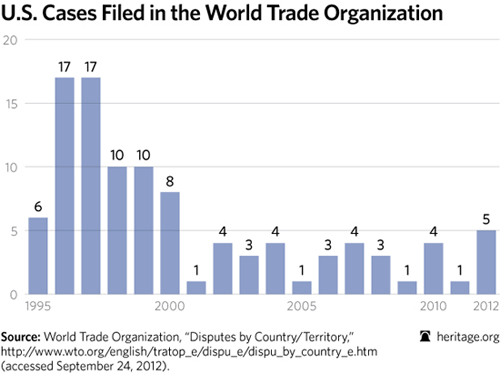
U.S. cases in the WTO decline - A statistic

This graphic shows the WTO cases filed by the U.S. at the Dispute Settlement Mechanism. A substantial decline in cases bright forth from the initial days of the WTO. 

Signs of more political compromise, less trade friction or just circumstances?


Hat tip to The Foundry for highlighting this here in a different context .


Thursday, October 11, 2012

Globalization, judiciary and the middle path

I had written a post a few months back about the debate of constitutional sovereignty and globalization here in the context of the U.S. Constitution. Does globalization, epitomized by world trade rules, have a devastating impact on constitutional values and the power of the people or is it an expression of people's will through State consent?

I have often thought about the attitude of the national judiciary towards globalization and international trade rules. How are they viewed and how are the challenges of globalization, free trade, protectionism construed in the context of the Constitution and domestic legal regime. I found an interesting piece by a former Chief Justice of the Supreme Court of India wherein the issue of globalization and the way the judicial system should react is touched upon. The article dealt mainly with the way globalization impacted legal systems, but it had some important points for international trade law. Commenting on "protectionism" by both developed and developing worlds its said:
"On account of such complex social realities, it becomes very difficult to gauge the substantive benefits of foreign trade and investment. In such a scenario the onus is on the government and the legal system to devise strategies for ensuring a more equitable distribution of the pie. It is the concern with the prospects for our agricultural exports in foreign markets, which has prompted India􏰁s vehement stand against the policy of export-subsidies given to farmers in some Western countries. There is no foundational opposition to the reduction of tariffs and other trade barriers which will enable more foreign firms to trade in goods and services in India. However, Western governments should also be willing to reciprocate by removing the unfair advantages given to their respective agricultural sectors. If the same is done, Indian farmers will be able to improve their earnings from exports and the same will translate into meaningful development for our rural communities. Even though the negotiations at the WTO seem to have been stalled at the moment, there is no ambiguity about the merits of free trade. The only condition is that both the developed and developing nations should be equally committed to the reduction of trade barriers."
Stressing on following the "middle path" it continued:
"The lesson that all of us can conclusively learn from the tumultuous events of the past year is that while the belief in free markets may be well placed, there is an equally important role for governmental intervention in our respective economies. Extreme viewpoints favouring market-fundamentalism on one hand and governmental control on the other hand, will not help us in arriving at constructive solutions. In these uncertain times, it is incumbent upon Courts and regulatory agencies to embody the voice of reason, accommodation and compromise."
While there is no dispute that one must tread the middle path most of the time the issue is to find this middle path. What constitutes the middle path? Who decides what it is? Does the WTO law provide for a country to follow a middle path? Is it flexible enough to allow a judicious mix of policies to achieve national growth amidst reduced barriers? How should the judiciary in a country react to the challenges of globalization? Would holding international economic policy subject to constitutional values inherit the danger of international non-compliance? How should the friction between constitutional vaues and international obligations be reconciled? Are they irreconcilable at all?


Wednesday, October 10, 2012

Future of the WTO

Joshua Meltzer's detailed piece on the future of trade talks and the WTO is a brilliant exposition of issues involved and the possible way forward. 

(Doha talks)

Titled "The Future of Trade", this Foreign Policy piece highlights the criticality of concluding the Doha round, the increasing threat of Free Trade Agreements undermining the multilateral system, the pressures on an already overburdened dispute settlement mechanism, role of developing countries like China and India in the global governance agenda as well as the challenges the WTO will face in the coming years.

It concludes:
"Since its establishment, the WTO has delivered significant global economic benefits through the liberalization of world trade. As a key institution for global economic governance, the WTO has also stabilized the rules on trade and provided an effective dispute settlement mechanism to manage trade conflicts. This has given businesses the confidence to engage in the type of global trading strategies that have allowed a company like Apple to have iPod components manufactured and assembled in different countries and then shipped back to the United States, generating greater profits for Apple and ultimately providing a cheaper product to consumers.
Despite its indisputable benefits, the WTO currently faces a range of serious challenges. The most obvious challenge to the WTO is that it is losing its role as the primary vehicle for liberalizing trade. This has been driven by the difficulty in concluding the Doha round and the proliferation of free trade agreements. In fact, for some countries, FTAs will deliver deeper and broader trade liberalization than would be possible, at least at the moment, within the WTO. As outlined, the proliferation of FTAs is a fact, and the Doha round has effectively stalled."
An interesting read. 


Tuesday, October 9, 2012

A Global Recovery Round for trade negotiations required?

A lot has been written about the Doha impasse and the way forward. How does one move forward? What are the dangers for multilateral trade if the negotiations impasse continues?

The Economist had this to offer in a recent piece titled "Goodbye Doha, hello Bali".
"Instead of allowing the Doha round to be replaced with a patchwork of regional deals, the WTO’s boss, Pascal Lamy, should close it and resurrect the best bits in a “Global Recovery Round”. He should drop the all-or-nothing “single undertaking” rule that helped kill Doha. Instead, talks would be broken up into small chunks and allowed to progress independently of one another. Negotiations would be open, so that any member could leave or join. Some deals, therefore, would not include everyone. But another of the WTO’s guiding principles—the “most-favoured-nation” clause—must apply. This rule means that any deal between a smaller group must be applied to all WTO members, even if they do not reciprocate. WTO-brokered regionalism would thus lower trade barriers for all. 
The Global Recovery Round should focus on manufacturing and services. Manufacturing represents around 55% of total trade. There is much to be gained: tariffs on cars, buses and bicycles are still high. Even low-tariff countries maintain a selection of high ones. In America ski boots attract a zero tariff, but golf shoes can face a 10% rate, and steel-toe-capped boots 37.5%. Services, which account for only 20% of world trade but are more important on a value-added basis, have hardly been liberalised at all."
Calling for a "Global Recovery Round" of multilateral trade talks, the way forward offered is:

1. Abandon the "single-undertaking" rule.

2. Move forward in specific areas independently of reach other and then apply the most-favoured nation principle. (How this would be acceptable to countries is difficult to fathom.)

3. Focus more on manufacturing and services and less on agriculture.

Pascal Lamy recently indicated that there were signs of a renewed interest n breaking the impasse.
"At this juncture, I believe we can and must explore those spaces, areas or topics on which we can make progress. We need to explore any and all options, small as they may be, for incremental progress on the negotiating agenda. Taking small steps now will be crucial for the credibility of the rule-making capacity of the WTO tomorrow. And as we take these small steps, we must also look at the wider picture, at the areas where progress has been more elusive, and start exploring and testing new approaches, including on so-called more intractable issues, to deliver results."
Whether Bali in 2013 would be the forum that where this can be achieved is debatable. A new WTO chief, a Global Recovery Round and lesser protectionism - hopeful prescriptions for 2013?