Showing posts with label benefits of trade. Show all posts

Monday, August 6, 2012

Time for a Trade Facilitation Agreement to break the Doha impasse?

The Doha round impasse in multilateral trade negotiations and the possible way forward has been the subject matter of many scholarly articles, discussions and vociferous debates. I have blogged about some of them here, here and here. Should the "single undertaking" condition be waived to seize low hanging fruit and move the negotiations forward? Are there areas in which both the developed and developing world can see a common benefit and agree to disagree on the rest? The Doha Ministerial Declaration in 2001 which began the Doha round of negotiations was clear on the 'single undertaking" when it stated:

"With the exception of the improvements and clarifications of the Dispute Settlement Understanding, the conduct, conclusion and entry into force of the outcome of the negotiations shall be treated as parts of a single undertaking. However, agreements reached at an early stage may be implemented on a provisional or a definitive basis. Early agreements shall be taken into account in assessing the overall balance of the negotiations."
A Project Syndicate piece by Robert Zoellick, Ahmad M.Al-Madani, Donald Kaberuka, Haruhiko Kuroda, Thomas Mirow, Luis A Moreno titled "How to Make Trade Easier" highlights the need for an offensive by the WTO to clinch achievable missions to make international trade more attractive to both the developed and developing world. Arguing that efforts must be made to make "trade easier, they have canvassed for a new "Trade Facilitation Agreement" to benefit all trading countries. Offence, in trying times, is the best form of defence.
"The WTO’s best defense of open trade is a good offense. A new WTO Trade Facilitation Agreement would benefit all by increasing developing countries’ capacity to trade, strengthening the WTO’s development mandate, and boosting global economic growth. More than a decade after the launch of the Doha Round of global free-trade talks, this agreement could be a down payment on the commitment that WTO members have made to linking trade and development.
Comments
Developing countries stand to gain the most from improving trade facilitation. The right support would help traders in poorer countries to compete and integrate into global supply chains.
Comments
There are rich opportunities for gains. Inefficiencies in processing and clearing goods put traders in developing countries at a competitive disadvantage. Outdated and inefficient border procedures and inadequate infrastructure often mean high transaction costs, long delays, opportunities for corruption, and an additional 10-15% in the cost of getting goods to market – even more in landlocked countries."
Implying  that a Trade Facilitation Agreement is a non-controversial subject, benefitting all countries it can be agreed upon coupled with capacity building and technical assistance to countries who need to implement it. 
"In international negotiations, there is always a way forward if the benefits of an agreement are shared by all. Trade facilitation offers a development dividend for all countries. It is time for WTO members to make progress on issues where there is room to do so. It will be a down payment on a solid investment."
 Some observations:

1. Will countries be willing to give up the "single undertaking" principle so easily? Can there be other such non-controversial subjects in the basket of negotiating agendas that can be agreed and implemented? 

2. On a more skeptical note, does Trade facilitation impact developing countries and the developed world equally? It is seen that less developed countries and some developing countries have archaic trade procedures that impact both their exporters and importers. Trade Facilitation will help simplify non-transparent rules and procedures. Is this a way of increasing access of developing countries markets to the developed world? The developed world already has better trade procedures which may not be impacted by the Trade Facilitation Agreement.

3. One area where the Trade Facilitation Agreement will certainly help is capacity building and infrastructure support to improve trading and reducing transaction costs. If it helps a poor exporter from a developing country to access developed markets, the Trade Facilitation Agreement is a welcome relief. However, the impact should not be one sided - improving access to developing countries markets while the developed markets remain a distant reality.

4. What is stopping countries from agreeing on a Trade Facilitation Agreement if it benefits one and all? Is it only the single undertaking pitfall or is there something more?




Monday, May 28, 2012

World Bank, Free trade and Globalisation - Some questions

The World Bank in a recent Report has summarised the costs and benefits of free trade to a country's economy. Elaborating on the benefits it said:
"For participating countries the main benefits of unrestricted foreign trade stem from the increased access of their producers to larger, international markets. For a national economy that access means an opportunity to benefit from the international division of labor, on the one hand, and the need to face stronger competition in world markets,on the other. Domestic producers produce more efficiently due to their international specialization and the pressure that comes from foreign competition, and consumers enjoy a wider variety of domestic and imported goods at lower prices.

In addition, an actively trading country benefits from the new technologies that “spill over” to it from its trading partners, such as through the knowledge embedded in imported production equipment. These technological spillovers are particularly important for developing countries because they give them a chance to catch up more quickly with the developed countries in terms of productivity. Former centrally planned economies, which missed out on many of the benefits of global trade because of their politically imposed isolation from market economies, today aspire to tap into these benefits by reintegrating with the global trading system."
Recognising the risks of free trade, the report continued:

" But active participation in international trade also entails risks, particularly those associated with the strong competition in international markets. For example, a country runs the risk that some of its industries—those that are less competitive and adaptable—will be forced out of business. Meanwhile, reliance on foreign suppliers may be considered unacceptable when it comes to industries with a significant role in national security. For example, many governments are determined to ensure the so-called food security of their countries, in case food imports are cut off during a war.

In addition, governments of developing countries often argue that recently established industries require temporary protection until they become more competitive and less vulnerable to foreign competition. Thus governments often prohibit or reduce selected imports by introducing quotas, or make imports more expensive and less competitive by imposing tariffs."
 It is increasingly seen that as a country integrated into the global economy its ratio of trade to GDP increases. In the developed world this ratio is upto 40% while it is less than 10% in the developing countries.  Globalisation and integration into world markets with an increase in trade and integration has immense benefits but it also brings with it concomitant risks. Can a country understand the dual effects and craft domestic policy to address the challenges in an integrated world? While trade would benefit certain sectors of the economy, it is beyond doubt that inefficient industries and sectors would wither away under international competition. This would inturn have disastrous consequences to domestic constituencies in terms of local economies, jobs and growth. One has to address this dichotomy in the overall strategy to globalise. Further the whole issue of "equitable globalisation" is extremely relevant. While people from different countries will increasingly access markets and the world economy will get globalised, a large segment will remain untouched. The State would remain as a strong provider of access to opportunity for those left out by the markets. However, trade policy experts must think of making global markets more inclusive in terms of giving a stake for a large section of population. Adoption of a free trade system must not necessarily mean the withdrawal of the State. One must tread the middle patha nd find the truth somewhere in between. the balance is not easy to find. Of what relevance is world trade and globalisation to a tribal woman in an interior village in Africa? Of what relevance is it to a marginal farmer in a developing country? How could the small, entrepreneur in a city benefit from international trade? How would an unorganised worker in an informal sector in an underdeveloped country visualise his or her stake in an international economy? International trade is not only about mega corporations or countries engaging in trading of products. It has far more strategic implications. To address issues and challenges of the 21st century we must ask ourselves how a less protectionist and liberal trade environment would benefit multiple stakeholders with multiple problems and issues. Answers to these questions perhaps would help assuage strong resentment within domestic constituencies about the ill effects of free trade and globalisation. There are no easy answers. But we need to recognise that the questions exist.


Monday, May 7, 2012

Trade benefits people's lives - How does one communicate this?

Pascal Lamy, Director General of the WTO recently spoke at the Minnesota Economic Club on how trade benefits the lives of people and challenging the myth that "protectionism" pays. I found a paragraph on the importance of communicating the benefits very pertinent:
"There is another important part of the trade agenda for which change is urgently required — how we tell the story of trade. In the communication age, you cannot persuade people without a compelling narrative.  One can build a very strong case for trade. We know as well that closing trade down is economically destructive and that instead of protecting jobs, protectionism actually destroys them. Yet, the political discourse on trade in the United States, and in many other countries, is cause for deep concern. Foreign companies and countries seemingly do not “play by the rules”. Imports are demonized. Most worrisome of all, trade is seen as a catalyst for job loss rather than job creation. Yet, the irony is that trade has been and continues to be an important American success story.
The link between trade and jobs is complex and when making the case for trade we need to acknowledge that there are those who are hurt by trade. We need to support programmes that help get such people back on their feet. But equally, we know that those countries practising open trade policies grow faster than those with closed policies. The World Bank tells us that they grow three times faster. Our joint study with the ILO said that the efficiency gains from trade lead to positive overall employment effects in numbers of jobs and the level of wages. We also know that jobs tied to exports pay better, 6 per cent better on average in the United States and 18 per cent better in Minnesota. The OECD points out that any link between unemployment and import penetration is tenuous. A survey of 23 OECD countries reveals that in 1970 the average unemployment rate in those countries was 3 per cent and the import penetration rate was just over 10 per cent. Today, the import penetration average has jumped to 45 per cent while unemployment, though elevated in this post-crisis economy, is at 8 per cent."
Lamy stresses the role of the WTO Secretariat in getting this message across:
So why is this story not getting out? We at the WTO accept our share of the blame. We can and will do better at explaining how trade improves the lives of most people around the world. Governments and universities need to do more as well. And, frankly, businesses need to lift their play as well. It is companies, after all, which engage in trade, which seek new markets and which benefit from access gained to those markets.
We in the WTO Secretariat have been working hard to establish closer contacts with the business community. We have been hosting seminars at which we explain how we work and why things sometimes don’t work. We have increasingly offered businesses the chance to tell us how we can do better and we plan to do more on this front in the future.
True, we are a member-driven organization and decisions are taken by consensus. But there are things that we in the Secretariat can do to help as well. One of these things is to provide you with better data. Our Made in the World Initiative, for example, has brought to light a great deal of information on how global supply chains work and the impact they have on trade, growth and development. This sort of information can lead to more informed debate and better policy decisions."
The communication disconnect does exist. Has the information and benefits of international trade percolated to the national, state and local levels? Does it seem being too irrelevant to people's daily lives? As developing countries integrate into global economies the relevance and critical importance of international trade will loom large with diverse impacts, benefiting some while disrupting others. Has this been understood and communicated by the domestic leadership to their people? Domestic politics is often preoccupied with varying challenges of differing complexity. The debate on trade often gets intermingled with the issue of protecting one's domestic constituent's interests. Ofcourse, to expect that international trade will be  beneficial in all sectors would be naive. However, to demonise it and fall back into the trap of protectionism too would be disastrous. How can the benefits of trade to people's lives (everyday lives) as opposed to statistics like GDP, growth and macro economic indicators) be communicated effectively?  Is there a way of bringing the benefits of trade to the sub national level and local levels. With democratic decentralisation and local governments being strong in many countries, is there a way to communicate this message to local governing units? After all they represent the pulse of the people also. Is there an interesting way of telling this story?


Tuesday, March 27, 2012

Mapping provincial interests to international trade

In an earlier post I had highlighted the mapping of the benefits of international trade to the "sub-national level" in the context of the USTR. Normally the impact of  international trade is analysed in terms of the benefit a country derives at the national level. However in a federal system such as India it would be useful to go to the next level of governance - the States and see how international trade has an impact on employment and growth at the State level as well as the dependency of the businesses at the State level on international trade.

The USTR website has the benefits of trade mapped to individual states. The Economic Survey of India 2011-2012 details out the exports of 15 states in India. It also highlights the inter state variance in growth as well as the difficulty in obtaining data about exports relating to the origin of states.
"Policy for Promoting State-wise Exports
7.45 Two States, namely Gujarat and Maharashtra,account for 46 per cent of exports from India as per the data on state of origin of exports of goods. If Tamil Nadu, Karnataka, and Andhra Pradesh, the next three states with more than 5 per cent share, are added to the top two, the share of the top five states would be 65.7 per cent. In 2010-11, the growth of exports from states was robust. Only Goa had negative export growth due to fall in ore exports owing to a ban on exports of iron ore by the Karnataka government. High export growth was registered by Odisha followed by West Bengal and Gujarat. In the first half of 2011-12 there was robust export growth in case of Karnataka, Uttar Pradesh, and Tamil Nadu.
7.46 The state-wise exports given in Table 7.16 are only indicative as there are many weaknesses in the data. These include the following. The figures are compiled as per the reporting from customs and no validation is done at the DGCI&S end. Only one state of origin code can be given by the exporter in a single shipping Bill. In case of shipping bills with multiple invoices containing items originating from more than one state, there is no provision for making different entries. In the customs daily trade returns (DTRs) the non-reporting of state of origin (STON) is considerable and exporters have a tendency to report the state to which they belong/ the state to which the port (through which the export has taken place) belongs/ the state from where they ‘procured’ the goods as the state of origin for those particular goods instead of the actual state of origin of goods. The problem is acute in the case of non-manufacturing exporters, who only know the place of procurement and not production of the goods. These weaknesses need to be rectified to improve the quality of data."
Building a state-specific database of exports and imports would help in analysing the benefits of global trade on sub-national interests. Since many domestic policies are driven by the provincial governments, this analysis would be useful to make meaningful domestic policy at the provincial level that can assess and utilise the benefits international trade offers. It would also require a high degree of co-ordination between the central and provincial governments. In the Indian context while there is a lot of debate at the national level about the multilateral trade rules and their impact on the domestic economy, similar interest and engagement at the provincial level is not seen. Only a joint collaboration of all tiers of government domestically can effectively engage with the international trading system and take advantage of the rules to create employment, growth and trade at the local level.


Tuesday, January 24, 2012

International Trade and Prosperity

An interesting piece in the Huffington Post by Stan Sorscher, labour representative for the Society of Professional Engineering Employees in Aerospace/IFPTE on the relationship between trade and prosperity, and what domestic trade policy ought to be, is found here:

"I work for a labor union in the aerospace industry. We are 100% in favor of trade. We make products the rest of the world wants to buy.

With increased trade we expect more prosperity. Instead, we see the American economy de-industrializing and job security at historic lows. So, what’s going wrong?


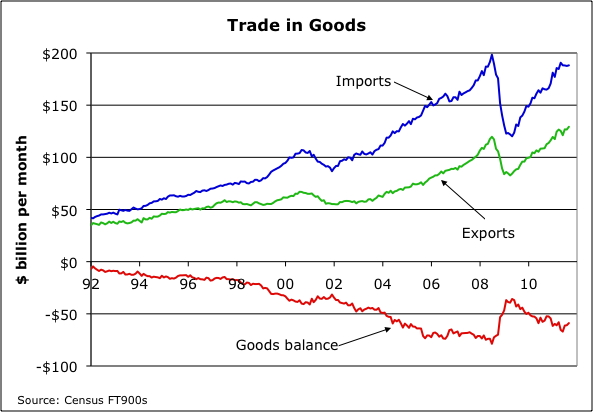
2012-01-10-ExportsImports.jpg
Figure 1. US Trade in goods since 1992.
Figure 1 tells the story. Since NAFTA and WTO took effect around 1995, our trade deficit has widened steadily, except for the 2008 crash, which cut imports more than exports.


The language for trade is deceptive. We speak of “free trade agreements,” which sounds like freedom, and evokes the image of prosperity. Maybe we should call them “trade deficit agreements,” since that’s what they do.

We have alternatives. Today, many countries take a different approach to trade, and they run trade surpluses. Japan, Korea, Singapore, and Germany run trade surpluses and they have high living standards. China’s very effective industrial policies are the opposite of free trade. Their growth is phenomenal. It could be even more impressive if workers and communities in China had more say in how their gains were allocated. (Please finish this post, then get a cup of coffee, sit down and listen to this sensational radio piece.)

When America industrialized, we rejected free trade (trade deficit agreements), and our living standard rose dramatically.

Since NAFTA and WTO took effect, factories in America closed, entire industries declined, and millions of good jobs moved offshore. China’s industrial policies are a credible threat to our aerospace industry – one of the last bright spots in our trade profile. Technology and capital for new industrial capacity goes to China, India, and Russia, rather than Michigan, California or Pennsylvania.

In America, workers are pressured to accept wage cuts, loss of job security, elimination of pensions, and more shifting of medical costs. Maybe we should start calling free trade agreements “de-industrialization agreements.”

Why do we insist on an underperforming trade policy that enriches a few, and undermines civil society in America and abroad, while doing little good or real harm to workers and communities?

What if we could have trade AND prosperity? We should be thinking about different and better trade agreements, not more NAFTA-style de-industrialization agreements.

A different trade policy should reflect our own values and history. We forbid child labor and sweatshops. We have minimum wage laws and labor laws with basic worker protections that helped build a strong middle class. We protect clean air and clean water, which are essential for public health. We regulate food and drugs, which builds trust in the most basic interactions between businesses and consumers. We set a high standard (maybe not high enough) for regulation of banks and financial markets. As we industrialized, we chose policies and values for our own domestic economy that created a prosperous middle class and raised living standards.

Free trade policies create trade deficits because they are designed to protect U.S. companies who want to move production to countries that ignore human rights, punish workers for forming unions, silence dissent, pollute the environment, and put public health of their own citizens at risk. The Korea-US trade deficit agreement specifically strips away legitimate and prudent financial controls enacted by Korea to prevent financial bubbles. Maybe we could call free trade agreements “agreements to undermine civil society at home and abroad.”

Each time we pass a new trade deficit agreement, we are endorsing bad behavior that we would never accept in our domestic policy. Worse than that, we are putting our own domestic producers at a disadvantage for keeping their production in America.

Remember: the question is not free trade versus protectionism. Members of my union and everyone I know, really, are 100% in favor of trade. We support exporting apples, wheat, airplanes and cars. We support importing coffee, and flat screen TVs. We support foreign investment in new industrial capacity. We are 100% in favor of trade.

The question is good trade policy with an upward spiral, or bad trade policy with a downward spiral. Other countries are doing a good job of playing the cards they were dealt; we are playing our cards badly. We look like the sucker at a poker game.

American trade negotiators are working on the next big trade deal, called the Trans-Pacific Partnership. Already, multinational companies are demanding that worker protections in TPP be as weak as possible. They prefer no protections at all.

Respected mainstream economists argue that under our “agreements to undermine civil society at home and abroad,” low-wage countries will eventually enjoy prosperity, perhaps with civil unrest and violence along the way. Probably so. Wouldn’t we prefer that developing countries achieved a better life because of our good trade policy, rather than in spite of our bad trade policy?

When we ask for trade policies that encourage investment in our domestic economy, and set reasonable standards for human rights, labor rights, the environment, public health and legitimate financial regulation, we are helping ourselves by balancing the interests of workers and communities in America and elsewhere, with the interests of businesses and investors. That’s the way we built a strong middle class in America. It should be the foundation of our trade and economic policies."


This is not "protectionism", is it? 


Wednesday, November 30, 2011

Benefits of trade liberalisation

Domestic politics has always been dominated in many countries by issues of multilateral trade liberlisation, globalisation and the WTO. Often issues are viewed in terms of domestic sovereignty vis a vis an international imposition of rules that are detrimental to the national interest. While 153 countries are members of the rule-based multi lateral organisation, often benefitting from the transparency that the WTO agreements mandate, vociferous opposition to trade liberalisation and reduction of trade barriers is witnessed across the world, across the political spectrum.

As the US is going to Presidential election in 2012, an interesting analysis of possible presidential nominees and their attitudes towards free trade is captured well in this report. Though the report rues the fact that trade related issues do not get centre stage because of other,more pressing, domestic issues, the views over time of the potential presidential candidates on trade has been analysed. Many amongst them are critiques of the WTO and trade liberalisation per se.

Often, in the political discourse across the world,  we see that contradictory positions are taken vis a vis the WTO based on what is perceived as national interest. When it is in the interest of a country's producer/manufacturer to access markets abroad, the transparent rules of the WTO and "national treatment" principle is quoted as the guiding principles to be followed by all concerned. When it comes to protecting one's own local manufacturers against foreign competition based on the same rules, fears of losing sovereignty are raised. It is obvious that a country is going to benefit from trade liberalisation as well as lose out in certain sectors. It is how one's interests are protected within the rule based system that is of crucial significance.