Showing posts with label DSM. Show all posts

Sunday, February 24, 2013

WTO dispute settlement and China-US trading relations

The dispute settlement mechanism of the WTO has been hailed as the crown jewel of the multilateral system providing an avenue for trading partners to resolve intricate and complex trade disputes within a rule based system. It is often compared to the more 'political' power based negotiation process wherein relative economic strengths and other factors influence decision making.

A good insight into China-US trading relations in the context of their disputes at the WTO is found in this piece by Ka Zeng which essentially argues how the dispute settlement mechanism of the WTO has averted any major trade war between the two trading superpowers.It has also been used by both the countries effectively to pursue their national interests.
"All this suggests that the WTO DSM has become the primary means for handling politically salient issues for both countries.  If this is the case, the growing utilization of the DSM in the past decade may have helped to channel the tensions surrounding the bilateral trade relationship and prevented intense interest group pressure from impairing overall U.S.-China trade relations. In the absence of the DSM, it is possible that major bilateral trade disputes resulting from China’s ever-growing trade surplus with the U.S. and allegations of the undervaluation of the Chinese currency could have generated far more acrimony and tensions in bilateral economic relations."
Her full article on this interesting aspect of China-U.S trading relations is found here


Sunday, October 28, 2012

Airbus Boeing dispute - State support a hard reality

The Boeing-Airbus dispute at the WTO dispute settlement mechanism has been debated and discussed widely. Incidentally books to have been written on the subject. It offers a classic case of the failure of the dispute settlement system to provide a verdict in a timeframe. I have blogged about it here, here and here.

Jennifer Smith has a good synopsis of the two longest (and perhaps biggest) disputes at the WTO here. She has traced the history of both the disputes (Airbus and Boeing) and summarized the issues involved. Stressing on the importance these two cases have on the economy of the U.S. and the EU, she notes:
"These disputes may prompt negotiation of a new agreement regarding civil aircraft subsidies, and mayhave an impact on production and export competition in the civil aircraft industry. Civil aircraft are a top U.S. export, have a larger trade surplus than any other manufacturing industry ($47.2 billion), and support more U.S. jobs through exports than any other industry. The cases also have broader implications for the WTO system. Because of their massive factual records, both cases have already significantly impacted the WTO’s dispute settlement process. The cases also gave the WTO dispute settlement system an opportunity to flesh out anti-subsidy rules agreed to by WTO members in 1994 – they thus provide a potential roadmap for future challenges to government support programs for key industries. 
The industries involved and the records in the disputes were of an unprecedented magnitude. The disputes involve the largest dollar value by far of any WTO case to date — more than $2 trillion for the total plane market.The WTO had to bend its own procedural rules to handle the cases. Normally, WTO Panels aim to issue reports within six months.In both the Airbus and Boeing cases, the Panels’ decisions took more than five years."
The impact the two cases have on the WTO dispute settlement system is immense. It has tested the limts of the system as well as offered new jurisprudence on the interpretation of the ASCM and the extent to which the State can support industry. Commenting on the implications of the Airbus and Boeing disputes for the WTO DSM she rightly concludes:
"Furthermore, the disputes indubitably have far-reaching consequences – not only for Airbus and Boeing, or the United States and EU. The massive factual records at issue in the disputes tested the WTO dispute resolution system nearly to its limits. The inability of the system to issue findings in the disputes in a timeframe anywhere near the schedule provided for in WTO rules suggests the system may need additional resources or procedures to effectively handle such complicated disputes in the future. If the system does not provide parties with a timely and meaningful dispute resolution mechanism in such large cases, its relevance may diminish. 
In addition, the disputes demonstrate how difficult – yet necessary -- it is to effectively discipline subsidies that, even though they are not expressly contingent on exports or domestic content, nonetheless have massive trade-distorting effects. In the case of de facto export subsidies, the Appellate Body has established a test requiring a demonstration that the subsidy is “geared to induce the promotion of future export performance” – how difficult this test will be to meet in fact is likely to be the subject of future disputes. In addition, the disputes provide a roadmap of the kind of evidence that is required to demonstrate that domestic subsidies have caused serious prejudice and are thus actionable under WTO rules. It is vitally important that these rules be administrable and enforceable if the SCM Agreement is going to provide an effective means of disciplining not only the most blatant prohibited subsidies, but also the full array of subsidies that distort global trade."
I am just amazed at the extent to which countries go to support local industry when jobs and national growth are concerned. State support for aircraft manufacturing is clearly evident here. A talk about a plurilateral agreement covering aspects of State support for aircraft manufacture is being made. While subsidies are frowned upon by the ASCM, here are two cases that clearly stand out as classic examples of generous State support for industry in violation of the ASCM. While these two industries are important for the U.S. and EU economies (even to the extent of justifying a plurilateral agreement) what prevents other WTO countries from supporting "national" industries that provide lot of jobs in their respective countries. What implications does a longstanding dispute have on the compliance of the ASCM by other countries? In both cases the Appellate Body has given its decision. The complexity of the subject has resulted in the battle shifting to the area of compliance. While, at the end of the day, these cases might cull out fine jurisprudential principles for the interpretation of the ASCM, it is undeniable that State support for local industry is a hard reality in both the developed and developing world. Would countries have the moral authority to insist that States do not support particular industries when in fact it is such a hard reality?


Friday, October 12, 2012

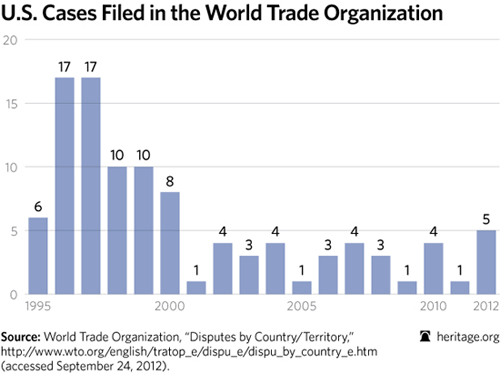
U.S. cases in the WTO decline - A statistic

This graphic shows the WTO cases filed by the U.S. at the Dispute Settlement Mechanism. A substantial decline in cases bright forth from the initial days of the WTO. 

Signs of more political compromise, less trade friction or just circumstances?


Hat tip to The Foundry for highlighting this here in a different context .


Wednesday, October 10, 2012

Future of the WTO

Joshua Meltzer's detailed piece on the future of trade talks and the WTO is a brilliant exposition of issues involved and the possible way forward. 

(Doha talks)

Titled "The Future of Trade", this Foreign Policy piece highlights the criticality of concluding the Doha round, the increasing threat of Free Trade Agreements undermining the multilateral system, the pressures on an already overburdened dispute settlement mechanism, role of developing countries like China and India in the global governance agenda as well as the challenges the WTO will face in the coming years.

It concludes:
"Since its establishment, the WTO has delivered significant global economic benefits through the liberalization of world trade. As a key institution for global economic governance, the WTO has also stabilized the rules on trade and provided an effective dispute settlement mechanism to manage trade conflicts. This has given businesses the confidence to engage in the type of global trading strategies that have allowed a company like Apple to have iPod components manufactured and assembled in different countries and then shipped back to the United States, generating greater profits for Apple and ultimately providing a cheaper product to consumers.
Despite its indisputable benefits, the WTO currently faces a range of serious challenges. The most obvious challenge to the WTO is that it is losing its role as the primary vehicle for liberalizing trade. This has been driven by the difficulty in concluding the Doha round and the proliferation of free trade agreements. In fact, for some countries, FTAs will deliver deeper and broader trade liberalization than would be possible, at least at the moment, within the WTO. As outlined, the proliferation of FTAs is a fact, and the Doha round has effectively stalled."
An interesting read. 


Tuesday, September 18, 2012

China-US lock horns at the WTO, yet again

Tit for tat season at the WTO dispute settlement? September 17th saw two cases for request for consultations:
1.The United States notified the WTO Secretariat of a request for consultations with China on “China’s measures providing subsidies such as grants, loans, forgone government revenue, the provision of goods and services and other incentives contingent upon export performance to automobile and automobile-parts enterprises in China”.The details of the nascent dispute are found here. 
2.China notified the WTO Secretariat of a request for consultations with the United States on countervailing and anti-dumping measures applied to a wide range of products exported by China to the US. Among the products cited by China, affected by the measures, are paper, steel, tyres, magnets, chemicals, kitchen appliances, wood flooring, and wind towers. Further information will be available within the next few days in document WT/DS449.
The United States and China continue to play out their trade wars at the WTO. After the China Electronic Payments case, Mineral export restrictions case, the U.S. has taken on the alleged subsidies in the automobile sector. China is likely to request for consultations against alleged US subsidies to renewable energy programs.

Stewart and Stewart has done this study on the Chinese automobile sector that outlines the support given by the Chinese State to its automobile sector. How much of it violates the WTO Agreements, especially the ASCM, requires a thorough legal analysis. The study concludes:
"Many nations view their automotive sectors as economically and politically important, and support those industries through an array of government policies. In the case of China, however, these policies appear to be preying on other countries’ industries and violating China’s international trade obligations. When China joined the WTO, it committed to eliminate domestic content requirements and other programs that discriminate against imports, cease forced technology transfers, terminate export subsidies, and limit export restrictions. This report reveals that such practices continue to be routine in China’s automotive sector. Not only are such requirements still on the books and implemented in practice, China has recently proposed expanding such policies to cover new-energy vehicles and parts. These policies have fueled a massive increase in China’s vehicle and parts production and its rising exports to the rest of the world. If these policies intensify under the 12th Five-Year Plan, the effects will be felt not only in China, but in the United States and other automotive markets around the world."
Surcharged times at the WTO dispute settlement mechanism.  


Wednesday, September 12, 2012

Trade war redefined

Increasingly, signs of "protectionist measures" are seen in trade policy across the world. Experts have attributed this to a rising protectionist wave that could severely challenge the multilateral system. With the Doha round in an impasse, policies that do raise barriers to trade cause tremendous friction between trading partners.

This friction is reflected in two kinds of action - first, a tit for tat protectionist measure which leads to more protectionism in the ecosystem and second, a tit for tat WTO litigation. While the former increases the chances of protectionism, the latter tends to ease the situation with a claim for bringing down the barriers.

Simon Lester has this succinct piece in the Cato blog where he discusses the "new kind of trade war" - litigation at the WTO. We have seen that recently in the context of Argentina.
"Complaints at the WTO do not always lead to a finding of violation of trade rules, of course.  The rules are complex and every case must be evaluated on its own merits.  But nevertheless, the notion that, in the current version of a trade war, challenges to trade restrictions will be met with challenges to other trade restrictions is a vast improvement over the old-style trade war.  With trade negotiations progressing so slowly these days, we should be happy if trade litigation can bring about some degree of liberalization. 
It is worth noting that there are potential pitfalls.  The WTO litigation system could be overwhelmed with cases; and in the search for cases to bring in response, countries might choose to file somewhat frivolous cases that might not otherwise have been brought.  But despite such concerns, a shift away from the old-style trade war is of great benefit to the world trading system and to the cause of free trade."
Whether the WTO can handle a floodgate of such requests is open to debate. It would test the capabilities of the "crown jewel" of the international trading system. However, the more pertinent issue is, how would countries deal with this deluge? It would call for enhancing legal capacity, cross sectoral analysis with multi-stakeholder teams and a national strategy to succeed at the WTO.


Wednesday, August 29, 2012

Doha retreating? - Bhagwati and the future of dispute settlement

Jagdish Bhagwati writing in The American Interest narrates the reasons for the failure of the Doha round of multilateral trade negotiations inspire of more than a decade of sustained deliberations. While the reasons for the failure are many, Bhagwati narrates the various options that countries had in terms of concluding the Doha round and the main causes for the impasse. 
"Where does that leave us, however? There is great complacency that the fall of Doha is no cause for lament and that the WTO as the apex institution for trade will survive intact. It is as if loss of faith in Catholicism will not affect the Vatican. Doha has three legs: multilateral liberalization; framing of trading rules; and the Dispute Settlement Mechanism. The first is now broken. In turn, it cannot but break the other two."
This raises many concerns for the Dispute Settlement mechanism. It is considered the crown jewel of the WTO. However, what impact does the failure of the Doha round have on the existing judicial process. Some believe that the DSM would be unaffected and would continue to do what it does best - judicially interpret existing texts and adjudicate disputes systematically. Others, like Bhagwati, believe that it would have a negative impact on the DSM. When the political side of the multilateral system fails to change with changing times, the pressure is on the judicial wing to address new realities as well as address new concerns. This puts a lot of pressure on treaty interpretation as well as the judicial system. It can also lead to "judicial activism" wherein the adjudicatory bodies overstep their limits to address inadequacies of existing rules. While judicial activism in the national context is accepted by different institutions as inevitable and constitutionally mandated, how would a strong, forceful and often "judicially active" panel and Appellate Body be viewed by member countries/ Would it lead to increased compliance to international trade law or a growing discontent and non-compliance? Will the DSM be able to withstand the pressure of such non-compliance?

Another danger that is predicted with the failure of Doha is the rise of PTAs and their impact on the DSM. Bhagwati notes:
"In the absence of MTNs like Doha, these PTAs will also become the arrangements where rules such as anti-dumping and subsidies codes will be set and will then be muscled into WTO at Geneva. Similarly, the Dispute Settlement Mechanism at the WTO, a proud achievement in 1995, will also be in danger of falling into disuse as bilateral and regional dispute settlement arrangements will take over: and where the hegemons will expect that this asymmetric power will get them more favourable adjudication. None of this is cause for celebration; rather it calls for lamentation."
Thus, this would lead to the DSM gradually becoming irrelevant in multilateral trade relations. What would be the future of the DSM in the absence of a renewed successful negotiation in the coming years? Would it be strengthened or wither away into oblivion? Would it remain the crown jewel or just a disused bracelet?  Time, as usual, will tell.

Friday, August 24, 2012

Vsego Dobrogo (All the Best) Russia!


Russia finally is the 156th member of the multilateral trading system bringing to an end 18 years of negotiation. News of the membership trickled in here, here, here and here. Various analysis and comparisons with China are beginning to be made. Will russia take advantage of the WTO as China did? Will WTO be the magic wand that Russia will use to boost it's economy as China did? i have earlier blogged about Russia's entry here, here and here.

The WTO website has a detailed table on the progress of the accession process from June 1993 to December 2011.

1.Application ReceivedJune 1993
2.Working Party Established16-17 June 1993
3.Memorandum1 March 1994 (Goods)
27 October 1995 (TRIMs)
21 November 1995
25 October 1995 (Services)
25 October 1995 (TRIPS)
7 April 1997
9 April 1997
4.Questions and Replies2 June 1995
5.Meetings of the Working Party17-19 July and 4-6 December 1995
30-31 May and 15 October 1996
15 April, 22-23 July and 9-10 December 1997
29-30 July and 16-17 December 1998
25-26 May and 18-19 December 2000
26-27 June 2001
23-24 January, 25 April, 20 June and 16 December 2002
10 January, 6 March, 10 April, 10 July and 30 October 2003
5 February, 2 April,
16 July and 8 November 2004
17 February, 15 April, 24 June and 19 October 2005
23 March 2006
10 November 2011
6.Other Documentation
(a) Additional Questions & Replies24 January 2005
(b) Information on agriculture (WT/ACC/4)18 March 2008
(c) Information on services (WT/ACC/5)25 October 1995
(d) SPS/TBT checklists (WT/ACC/8)10 July 1997 (TBT)
11 July 2011 (SPS)
(e) TRIPS checklist (WT/ACC/9)25 October 2000
(f) Legislative Action Plan14 August 2007
7.Market Access Negotiations
Goods
(a) initial Offer
(b) Goods Schedule

16 February 1998
17 November 2011
Services
(a) initial Offer
(b) Services Schedule

8 October 1999
17 November 2011
8.Accession Package Approved by the Eighth WTO Ministerial Conference (December 2011)
Working Party Report
Goods Schedule
Services Schedule
17 November 2011
17 November 2011
17 November 2011

An interesting aspect of Russia's entry would be to analyze the impact of the protocol of accession on Russia's commitments. We have seen that the Chinese accession protocol uncharacteristically ran into more than 500 pages providing for WTO plus obligations for China which was reflected in disputes over export restrictions imposed by China.A look at the Russia's accession protocol gives a different picture. It is a brief document and does not seem to have similar provisions like China.However it refers to paragraph 1450 of the Working party report wherein Russia has agreed to specific commitments. Para 1450 of the Working party report states:

"1450.The Working Party took note of the explanations and statements of the Russian Federation concerning its foreign trade regime, as reflected in this Report.  The Working Party took note of the commitments by the Russian Federation in relation to certain specific matters which are reproduced in paragraphs 34, 72, 99, 115, 116, 117, 132, 133, 183, 209, 214, 215, 227, 251, 275, 302, 313, 319, 323, 324, 337, 351, 352, 353, 364, 366, 369, 382, 392, 417, 424, 472, 476, 477, 480, 481, 483, 486, 487, 497, 514, 527, 548, 562, 566, 574, 591, 613, 620, 638, 668, 669, 677, 698, 712, 714, 715, 719, 728, 738, 739, 744, 745, 756, 761, 765, 772, 773, 784, 785, 787, 789, 798, 799, 803, 804, 813, 826, 844, 847, 870, 875, 876, 880, 885, 890, 893, 895, 901, 904, 908, 923, 926, 927, 928, 932, 935, 936, 944, 950, 952, 955, 981, 984, 989, 1009, 1011, 1030, 1031, 1033, 1035, 1051, 1055, 1060, 1062, 1089, 1090, 1122, 1124, 1137, 1143, 1144, 1161, 1186, 1187, 1189, 1200, 1208, 1218, 1224, 1226, 1232, 1253, 1260, 1271, 1277, 1294, 1295, 1303, 1312, 1325, 1331, 1338, 1339, 1350, 1353, 1392, 1393, 1395, 1397, 1398, 1400, 1401, 1402, 1404, 1405, 1406, 1413, 1426, 1427, 1428, 1430 and 1449.  The Working Party took note that these commitments had been incorporated in paragraph 2 of the Protocol of Accession of the Russian Federation to the WTO."
Now, these are a lot of paragraphs and commitments and the devil is always in the details. One would have to make a more detailed analysis about whether Russia has agreed to onerous "WTO plus" commitments like China. Further, a dispute (now that Russia is a member its trade measures would be open to scrutiny under the DSM) would bring to the fore such commitments as in the case of China.A synopsis of Russia's commitments under the WTO have been provided here.

One would have to wait and see how Russia faces the multilateral challenge, what impact it's accession protocol will have on its WTO commitments, how engaging with the international trade network would benefit it's exporters and importers and how other countries would engage with Russia in the multilateral forum.

All we can say is "всего хорошего" (Vsego dobrogo) meaning "All the Best" in Russian!

Saturday, August 18, 2012

Will Russia cope?

Russia's entry into the WTO has been watched with great interest around the world. I have blogged about Russia's entry into the multilateral forum here, here and here. The consequences of Russia becoming a member of the WTO has been widely discussed. Experts have largely felt that while liberalizing trade would have an adverse impact on the local industry in some sectors, on the whole Russia will benefit from increased competition, market access and transparency.World Bank has analyzed the probable impact here. Reform of domestic laws to be in consonance with WTO rules would be a natural corollary.

A recent piece by David Collins in FT blog brings out the challenges Russia would have with it's WTO entry. Capacity to comprehend and effectively use trade rules to protect as well as advance one's national interest has been a recurring theme in this blog.The lack of capacity is a serious impediment that many nations face even after being in the WTO for decades. How would russia cope with this challenge. The piece rightly highlights the importance of building capacity to effectively engage with the WTO.
"Although Russia’s accession process has been planned for a number of years there remains a very significant knowledge gap within Russia regarding what WTO membership will mean to the country.  It is widely believed that many of the politicians who voted for (and against) WTO accession did not fully appreciate its implications in all sectors. The Russian government is eagerly seeking to recruit personnel with experience in international trade, including lawyers and economists.  Several hundred positions need to be filled in Moscow and Geneva and there is an insufficient pool of qualified professionals to draw from because Russian universities do not yet offer courses on the WTO. Clearly the development of a suitable foundation of local expertise in international trade could take some time. Until then foreign expertise will be needed, likely in the form of expensive American and European law firms.  The WTO itself sponsors a number of training initiatives and it is hoped that Russians will make use of these."
Multidisciplinary teams, both for negotiation as well as dispute settlement, is a way forward to address this issue. Indigenization of legal expertise and capacity to effectively engage with the quagmire of multilateral legal rules is a sine qua non of a strategic use of the WTO. How and when Russia will achieve this self sufficiency would be an interesting aspect of Russia's tryst with the multilateral trading regime.


Saturday, August 11, 2012

Can questions of fact be reviewed on appeal - Standards of Appellate review in the WTO

This post is about the powers of the Appellate Body of the WTO to go into questions of fact on appeal. To what extent can the Appellate Body of the WTO review a Panel's decision? Can it go into the facts of the particular case or should it limit itself to legal interpretation or principles of law? Can it overrule the findings of fact of the panel or is its power of judicial review limited to legal interpretations? What are the standards of Appellate review in the DSU of the WTO? Often a case involves complex issues of fact and law. An appreciation of facts sometimes intertwines with the interpretation of law. Should the Appellate Body intervene in these circumstances or should it concur with the Panel's decision on the findings of fact. It is also observed that the Appellate Body in many instances is constrained by a limited appreciation of facts of the Panel. Is it reluctant to explore the facts of the case and content to rely on the adequate or inadequate appreciation of facts by the Panel. On the other hand, is an inadequate analysis of law itself a question of law and thus explorable by the Appellate Body? The lines between what constitutes a pure question of fact, law and legal application of the law to the facts of a particular case get blurred in complex situations. An analysis of how the Appellate Body has dealt with these situations and the jurisprudence developed is a fertile area for research.

Simon Lester has raised these issues and more in an article titled "The Development of Standards of Appellate Review for Factual, Legal and Law Application Questions in WTO Dispute Settlement" in the Trade, Law and Development Journal.

Some of the relevant provisions of the DSU that address the issue of the contours of the Appellate Body's interpretative flexibility are Article 11 and Article 17(6) of the DSU.


Article 11 deals with the functions of Panels and states:

The function of panels is to assist the DSB in discharging its responsibilities under this Understanding and the covered agreements.  Accordingly, a panel should make an objective assessment of the matter before it, including an objective assessment of the facts of the case and the applicability of and conformity with the relevant covered agreements, and make such other findings as will assist the DSB in making the recommendations or in giving the rulings provided for in the covered agreements.  Panels should consult regularly with the parties to the dispute and give them adequate opportunity to develop a mutually satisfactory solution.

Article 17(6) of the DSU states that "An appeal shall be limited to issues of law covered in the panel report and legal interpretations developed by the panel."


While Article 17(6) is amply clear about the scope of an Appellate review, Article 11 gives leeway for the Appellate Body to exercise a wider ambit of judicial review. Simple questions of fact may be outside the scope of the Appellate body. On most occasions questions of fact and law do not overlap. However, an inconsistent application of law  to a set of facts, may require the interpretation of both the facts and the law. However, when application of law to particular facts becomes a complex issue of understanding the factual situation correctly or an inconsistent or non-objective assessment of the facts, Appellate review does play a role. There the simplistic distinction between law and fact disappear and converge into a complex quagmire of judicial appreciation and interpretation. 

As observed by Simon Lester:
"As a matter of policy, it may be desirable to give the Appellate Body a good deal of leeway in reviewing a panel’s examination of the measures that are being challenged. However, Article 17.6 explicitly narrows the scope of appellate review to ‘issues of law’ and ‘legal interpretations’. Arguably, the Appellate Body’s decision to consider the panel’s construction of the challenged measures, outside the context of WTO obligations, as a law application issue stretches the boundaries of this provision, as the Appellate Body seems to have taken a very broad view of what constitutes a law application question. The result of this interpretation is an expansion of the scope of issues over which the Appellate Body can exercise a review.  For those who think that appellate review is a good idea, this development may be a positive one. On the other hand, to the extent that the Appellate Body’s interpretation goes in a direction different than what the drafters intended, it may cause concerns."

To what extent the Appellate body might go to unravel facts in an Appellate review would depend on the particular facts and circumstances of each case (We lawyers love this phrase - "depend on facts and circumstances of each case"). However, the limits of Article 17(6) and the purpose of an appellate review to decide on matters of legal interpretation might hold it back. It would be worthwhile to make an analysis of the cases where the Appellate Body has crossed the line? Or perhaps, it draws the line itself, so never crosses it.


Tuesday, August 7, 2012

Bali, WTO and Indonesia

(Bali, Indonesia)

Indonesia was in the news with respect to the WTO for entirely two different reasons. Firstly, it agreed to host the 9th Ministerial Conference of the WTO in Bali, Indonesia in December 2013. The 8th Ministerial Conference was in Geneva in December 2011. I have blogged about it here and here.The Ministerial Conference is the highest decision making body of the WTO which meets every 2 years.

 Indonesia, while offering to host the 9th Ministerial Conference stated:
“In the situation where crisis is still hampering the global economy, Indonesia continues to believe that the multilateral trading system has a significant role in fostering a fair global trade, sustaining the world economic growth, eradicating poverty and creating job opportunities. In this regard, the next MC9 will therefore be very important to re-energize the negotiation process and the progress achieved so far, and to strengthen the multilateral trading system. Finally, Indonesia fervently hopes that the exotic ambiance of the land of the gods and goddess, the warm weather and the hospitality of the people of Bali, will rejuvenate and renew the constructive spirit of the Doha Development Agenda negotiation in the WTO.”
A chance to change gears for the Doha round in the serene environs of Bali?

Secondly, Indonesia initiated a dispute with the EU with a request for consultations with respect to importation of fatty alcohols on which EU had imposed anti-dumping duties.
Indonesia has been a rarely reluctant participant in the Dispute Settlement Mechanism of the WTO having been a complainant in only 5, a respondent in 4 cases and a third party only in 4 cases, so far.

As they say in Indonesian, Salamat Datang (Welcome) to Indonesia?


Monday, July 30, 2012

To comply or not to comply - Dolphin safe labeling in the U.S.

The Dolphin Safe Tuna case at the WTO has generated considerable debate and discussion in terms of the interpretation of the TBT Agreement as well as the next steps related to compliance for the U.S. The WTO Appellate Body had ruled against the labeling scheme as being inconsistent wit Article 2.1 of the TBT Agreement since it treated Mexican tuna products less favorably than U.S. tuna products. The case also raises the issue of the right forum for the dispute since NAFTA mandates the disputes of such a nature to be brought before it's adjudicatory process.  I have blogged about the case here, here and here.

ASIL Insights has a piece recently that highlights the importance of the case for WTO jurisprudence. Elizabeth Trujillo in her piece titled "The WTO Appellate Body Knocks Down U.S. “Dolphin-Safe” Tuna Labels But Leaves a Crack for PPMs" explains in great detail the interpretation of various provisions of the TBT Agreement and its impact on non-product related process and production measures (PPMs).
"US—Tuna II is a landmark case for the trade and environment relationship and, more specifically, for the future adjudication of technical regulations under the TBT Agreement. In finding the U.S. labeling scheme inconsistent with TBT Article 2.1, the Appellate Body effectively characterized a measure based on non–product–related PPMs as a discriminatory technical regulation. However, the case leaves open the applicability of the TBT Agreement to PPM-based regulations in general—a controversial issue especially for developing nations because of the effect such regulations may have on market access of their products."
I am not going into the details of the AB report here as this has already been done. the focus of this post is an interesting reference to views in the U.S. not to comply with this decision. Eyes on Trade has referred to them here. A letter from a few U.S. Senators has urged the U.S. Administration not to abandon the labeling scheme:
"We are deeply disappointed by the WTO's final ruling, but we stand firmly committed to the Dolphin-Safe label. Let us be clear - Congress has no intention of repaying or weakening the current law applying to this label. Therefore, we request your assistance in developing a solution of complying with the ruling that maintains the current level of protection for dolphins."
Can the U.S. "develop a solution" that both complies with the WTO ruling as well as does not change the labeling scheme? Would extending the same certification standards and regulatory strictness to non-Eastern Tropical Pacific (ETP) regions be sufficient to ensure compliance?

The issue of compliance in WTO law is a complex one. What constitutes compliance in the present case. Striking down the labeling scheme would be one way to comply with the ruling. But would it be the only way? Are there other innovative ways to comply with the ruling, yet maintaining the same labeling scheme? This once again brings out the fact that a country can creatively engage with the WTO system to protect one's perceived national interest. How the U.S. would comply in this case is a matter of conjecture at this stage. Domestic interests and compulsions would probably shape the nature and form of U.S. compliance in this case.


The more important point is that even after a WTO ruling has been given there is debate internally in the country as to whether there should be compliance. In other words, the options before a member in a WTO dispute does not end with the WTO ruling. With strategic lawyering and creative interpretations, one may still continue with the old measure but remain in compliance. This, however, also raises issues about the efficacy of the WTO DSM which is based on a rule based system and an adjudicatory process hat ensures compliance or retaliation. It is one thing not to comply and face retaliation as per the DSU, but quite an other thing to continue with the measure that was held to be violative but to claim compliance.

Interesting times for WTO jurisprudence.