Showing posts with label ASCM. Show all posts

Tuesday, February 26, 2013

EU and Japan also appeal - Ontario case becomes more interesting

I have blogged about the Canadian FiT case at the WTO case here, here and here. News of Canada appealing the matter was reported here. It was not surprising since Canada had lost the case and was contesting the finding of the panel report that it had violated the provisions of the TRIMS and GATT.

Reports of the EU and Japan cross-appealing caught my attention. This would presumably be mainly on the interpretation of the provisions of the ASCM, especially the definition of a subsidy and benefit.

It is clear that the Appellate Body would decide the legal contours of this dispute, especially the compatibility of local content requirements with WTO law in the context of governments guaranteeing a minimum feed in tariff. With a number of countries across the world, both developing and developed, having massive renewable energy support programs (many of them with local content requirements), the AB ruling all be keenly awaited. One hopes that going by timeframe of the Antigua and Airbus-Boeing cases at the WTO dispute settlement, the wait for a closure is not too long!

Saturday, February 9, 2013

U.S. challenges India's renewable energy program

It seems to be the week of renewable energy in international trade law circles with the United States requesting consultations with India in relation to domestic content requirements in India's national solar program.

The USTR carried this piece:
"United States Trade Representative Ron Kirk announced today that the United States has requested World Trade Organization (WTO) dispute settlement consultations with the Government of India concerning domestic content requirements in India’s national solar program. India’s program appears to discriminate against U.S. solar equipment by requiring solar energy producers to use Indian-manufactured solar cells and modules and by offering subsidies to those developers for using domestic equipment instead of imports. These forced localization requirements of India’s national solar program restrict India’s market to U.S. imports. Tackling these barriers is a top priority of the Obama Administration. 
... 
On January 11, 2010, India launched its national solar policy, the Jawaharlal Nehru National Solar Mission (JNNSM). Phase I of that national policy is composed of two parts: Batch 1 and Batch 2. Under Batch 1, India required developers of solar photovoltaic (“PV”) projects employing crystalline silicon technology to use solar modules manufactured in India. Subsequently, under Batch 2, India expanded this domestic sourcing requirement to crystalline silicon solar cells as well. In its draft policy for Phase II of the JNNSM, India has stated that it is considering expanding the scope of the domestic content requirements further to include solar thin film technologies, which currently comprise the majority of U.S. solar exports to India. India also offers solar energy developers participating in the JNNSM a guarantee that the government will purchase a certain amount of solar power at a highly subsidized tariff rate, provided that they use domestically manufactured solar equipment instead of imports. 
These elements of India’s national solar policy appear to be inconsistent with India’s obligations under the WTO agreements. These obligations include Article III of the General Agreement on Tariffs and Trade 1994 (GATT 1994), which generally prohibits measures that discriminate in favor of domestically produced goods versus imports; Article 2 of the WTO Agreement on Trade-Related Investment Measures, which prohibits trade-related investment measures that are inconsistent with GATT Article III; Article 3 of the WTO Agreement on Subsidies and Countervailing Measures (SCM Agreement), which prohibits conditioning a subsidy on the use of domestic over imported goods; and Article 5 of the SCM Agreement, which prohibits causing adverse effects on other WTO Members through subsidies that discriminate against imported goods."
The case has been widely reported herehere and here.With Canada appealing the feed in tariff case at the WTO (that came to a finding that domestic content requirements int he Ontario context were violative of Canada's obligations under TRIMS and GATT) and the US requesting for consultations on this issue, will 2013 be the year where renewable energy support programs around the world will be challenged at the dispute settlement mechanism?


Monday, January 7, 2013

A currency dispute at the WTO in 2013?

Currency manipulation/undervaluation/misalignment has not yet attained centrality in WTO disputes or discussions except for a proposal made by Brazil at the WTO to take it seriously. There is abundance of legal literature, however, on the WTO compatibility of currency misalignment and the possible course of action under WTO law.The IELP blog  had a blogpost on it recently here. Does currency manipulation violate Article XV(4) GATT (frustrating the intent of GATT provisions) or is it a prohibited subsidy under the ASCM? I have written a paper on this which I will share soon.

The Peterson Institute for International Economics recently had a Policy Brief that highlighted the seriousness of the problem and recommended that a WTO case be brought against the major manipulators. the Policy brief titled "Currency Manipulation, the US Economy, and the Global Economic Order" gives an exhaustive account of what could constitute currency manipulation and contrary to popular belief that a few countries practice it there seems to be evidence that a large number of countries, both developing and developed, practice it.

 Recommending a WTO case, the brief highlights:
"We nevertheless believe that the status quo produces a gaping hole at the heart of the global economic order, that the bifurcation between the monetary and trading systems must be overcome, that the economic costs of inaction on this issue are extremely high during a prolonged period of slow growth and high unemployment such as the present and possibly the foreseeable future, and that multilateral remedies are highly preferable to unilateral actions. Hence we recommend that the United States and its allies bring WTO cases against the most egregious manipulators as part of a broader action program, all of whose other components would be at least arguably compatible with the existing international rules. If they won the case, it would strengthen their hands enormously in prosecuting all their other remedies and would, in a second WTO step to determine permissible remedial action, add to the arsenal of policy instruments available to them. If they lost, it would dramatize the need for reform of the WTO rules themselves and thus almost instantaneously place the issue on the agenda for either a future round or a stand-alone negotiation. Whatever the outcome, the coalition would have made every effort to use the existing rules and institutions and thus demonstrated its fealty to the international system."
While the legal arguments in favor of a WTO action in case of currency misalignment are not that sound, will 2013 see the first dispute settlement case where an undervalued currency is challenged on the grounds that it is violative of GATT or is a prohibited subsidy under the ASCM? Who will take the plunge?

Monday, December 24, 2012

Rethink on subsidies required?

The Airbus-Boeing dispute is one of the longest trade disputes that has dominated the WTO dispute settlement mechanism for years now. I have blogged about the issue here, here and here. Both the aircraft manufacturing giants allege, through their respective governments, that the other is a recipient of illegal subsidies that need to be scrapped. The WTO Appellate Body in both the cases has come to the conclusion that there have been illegal subsidies in both the cases. The dispute has reached the final stages of compliance and counter measures.

A recent piece in the Chicago Tribune tracing the history of the dispute called for a stop to the "launch aid" given by Europe to Airbus.
"In a surprising move that puts a welcome spotlight on launch aid, Germany reportedly held back the final 600 million euros of loans that it had promised. Alas, the decision has nothing to do with restoring fair trade practices. Germany is withholding its contribution to ensure that it gets a fair share of the jobs from the aircraft manufacturing it subsidizes.
 Nevertheless, even an internal European dispute over launch aid is a step in the right direction.Launch aid has got to go. The trade dispute between the world's leading markers of commercial aircraft has gone on too long. It must be resolved before it erupts into an all-out trade war — which could happen in relatively short order, by WTO standards."


While launch aid remains on the Airbus side, large subsidies on the Boeing side too needs to be addressed against which the WTO Appellate panel has found incompatible with WTO law. While China is normally in the dock for "subsidizing" its industry, the Airbus-Boeing dispute highlights the "all-pervasive" nature of subsidies in both the developed and developing worlds. Renewable energy is the next big area where the battle over subsidies is going to be fought. What should the international legal framework be in the context of renewable energy subsidies? Should it be different from aircraft subsidies as suggested by Gulzar here? Should we move towards a new phase of differentiation between different types of subsidies? Does the ASCM allow such a distinction? Do we need a rethink obout subsidies under WTO law?


Monday, December 3, 2012

Canada Ontario case - some thoughts before the decision

For followers of the Canada FiT case (DS 412 and DS 426) who have no access to the proceedings of the case at the WTO, the arguments advanced by the concerned parties have been more of an enigma. The WTO website which has an account of all the cases filed does not provide the details of the written submissions made by the parties. The decision of the Panel and Appellate Body would be put up on the website as and when they decide.

However, countries to the dispute can, of their own volition, put up their pleadings in the public domain n the interests of transparency. The EU, which has challenged the Canadian FiT program as being violative of the ASCM, has done so. The submissions are found here. The main thrust of the EU submission has been that the guaranteed FiT is a prohibited subsidy under ASCM due to the local content requirements.
"The European Union considers that the root of the problem in the present dispute is the inclusion of domestic content requirements in the FIT Program. The Government of Ontario, through the FIT Program, requires the utilisation of domestic equipment and components for certain renewable energy generation facilities in order to obtain guaranteed, above-market, long-term pricing for the output of those facilities. The need to counter this blatant discrimination between domestic and imported products crystallised as the national treatment principle in several provisions of the covered agreements and is at the centre of non-tariff barriers that must be eliminated in the context of the WTO's multilateral trading system.The pernicious effects on trade of such discrimination are multiplied by the provision of subsidies in the present dispute. Thus, the European Union considers that the relevant national treatment provisions of the SCM Agreement, the TRIMs Agreement and the GATT 1994 cited in the EU's Panel Request are applicable in this case."
An interesting aspect of the EU submission is the broad interpretation of "income or price support" under Article 1.1 of the ASCM which refers tot he definition of a subsidy. Relying heavily of the ordinary and dictionary meanings of these terms, the EU submission claims that the FiT program is an income or price support to the electricity generators.
"The FIT Program is a measure designed by the Government of Ontario to guarantee the price of the electricity supplied by the FIT Generators for a long period of time (20 years). As explained by Japan in its first written submission in DS412 and by the European Union elsewhere in this submission, the FIT Program operates as a price support system whereby the Government of Ontario, through its agency, the OPA, contractually agrees with the FIT Generators a rate and then pays such a rate directly (through another agency, the IESO) or indirectly (through LDCs) to the FIT Generators. The ultimate cost of the measure is borne by consumers, which contribute to the Global Adjustment when paying the electricity bills. Only in the rare case that the market rate (i.e. MCP/HOEP) goes above the guaranteed rates, the FIT Generator will receive payments for the supply of electricity under market conditions without the additional financial incentive created by the FIT Program. In the other (vast majority of) cases, the FIT Generator will obtain an above-market rate. Thus, the FIT Program provides "price" support (in the sense that agreed rates will always be above or at least at market rates) to electricity generated by the FIT Generators. At the same time, the guaranteed, above-market rates provide for "income" support of FIT Generators. Without those rates, the income or proceeds of the FIT Generators from the same amount of generated electricity supplied into the grid would be lower, following the lower and unsupported market rates."
These submissions made interesting reading since the EU itself has a large number of FiT programs at the national level. Would the stand of the EU be the same if its FiTs are challenged at the WTO? Can a member take positions based on whether it is a complainant or respondent? Obviously the particular facts and circumstances of each case will determine the legal position taken, but the EU submission just got me thinking of the scenario where another member would challenge a EU FiT as a prohibited subsidy. 

No more blogposts abut the Canadian FiT case until the Panel decision is made public!


Friday, November 2, 2012

Compliance in Boeing - A legal quagmire

I had blogged here about the recourse to Article 21.5 of the DSU by the EU against the U.S. in relation to the issue of compliance in the Boeing dispute here. More submissions dated 12th October by the EU here.

 The gist of the legal claim is here:
"28. The European Union considers that, after the end of the implementation period, the United States maintains a series of subsidies, within the meaning of Article 1.1 of the SCM Agreement through each of the measures listed in Section I, above. Each of those measures provides a financial contribution within the meaning of Article 1.1(a)(1), as detailed further in Section I, and confers a "benefit" within the meaning of Article 1.1(b) by providing the financial contribution on terms more favourable than would be available on the commercial market. Those subsidies are specific, within the meaning of Articles 1.2 and 2 of the SCM Agreement, as detailed further in Section I. 
29. Those specific subsidies presently benefit the development, production and sale of Boeing’s 737NG, 737 Max, 747, 767, 777 and 787 families of LCA, as well as any other future derivatives of these LCA families, including of the 777. Collectively, and under the conditions of competition present in the LCA markets, the subsidies listed in items I.A to G cause present adverse effects, in the form of serious prejudice, and threat thereof, to EU interests, inconsistently with Articles 5(c), 6.3(a), 6.3(b) and 6.3(c), including Articles 6.4 and 6.5, of the SCM Agreement. The effects of those subsidies adversely impact sales, market shares and prices of Airbus’ A320, A320neo, A330, A350XWB and A380 families of LCA. Specifically, the subsidies cause present serious prejudice, or threat thereof, to EU interests, in the form of: (i) displacement and impedance of EU imports into the United States, within the meaning of Article 6.3(a) of the SCM Agreement; (ii) displacement and impedance of EU exports to other third country markets, within the meaning of Article 6.3(b) of the SCM Agreement (including on the basis of Article 6.4 of the SCM Agreement); and, (iii) significant price undercutting, price suppression, price depression, and lost sales, within the meaning of Article 6.3(c) of the SCM Agreement (including on the basis of Article 6.5 of the SCM Agreement).  
30. In addition, the subsidies provided through the measures listed in items I.A to G are contingent, in law or in fact, on actual or anticipated export performance, and accordingly, are inconsistent with Articles 3.1(a) (including footnote 4) and 3.2 of the SCM Agreement. 
31. Moreover, the subsidy measures listed in items I.A to G are contingent, in law or in fact, on the use of domestic over imported goods, such that they are, accordingly, inconsistent with Articles 3.1(b) and 3.2 of the SCM Agreement.  
32. Through those same measures listed in items I.A to G above, the United States accords treatment less favourable to imported products than that accorded to like products of US origin, in law or in fact, inconsistently with Articles III:4 of the GATT 1994, and maintains internal quantitative regulations that require, directly or indirectly, that specified amounts or proportions of products be supplied from domestic sources, in law or in fact, inconsistent with Article III:5 of the GATT 1994. Moreover, the United States otherwise applies such regulations in a manner contrary to the principles set forth in paragraph 1 of Article III, including the principle that such laws, regulations and requirements and internal quantitative regulations should not be applied to imported or domestic products so as to afford protection to domestic production. 
Both the disputes (Airbus and Boeing) offer an opportunity for rich juriprudential churning in the area of subsidies under the WTO. It also highlights the complexity of claims, the intertwining of fact and law as well as the extent to which domestic policy is impacted by international law. From local city measures to national subsidy policy, the entire gamut of subsidy measures have been challenged by the EU. This dispute also tests the efficacy of the dispute settlement mechanism. WIll the U.S. comply with the Appellate Body order? What constitutes compliance? If nothing else, the complex quagmire of legalese is an international lawyers goldmine.


Sunday, October 28, 2012

Airbus Boeing dispute - State support a hard reality

The Boeing-Airbus dispute at the WTO dispute settlement mechanism has been debated and discussed widely. Incidentally books to have been written on the subject. It offers a classic case of the failure of the dispute settlement system to provide a verdict in a timeframe. I have blogged about it here, here and here.

Jennifer Smith has a good synopsis of the two longest (and perhaps biggest) disputes at the WTO here. She has traced the history of both the disputes (Airbus and Boeing) and summarized the issues involved. Stressing on the importance these two cases have on the economy of the U.S. and the EU, she notes:
"These disputes may prompt negotiation of a new agreement regarding civil aircraft subsidies, and mayhave an impact on production and export competition in the civil aircraft industry. Civil aircraft are a top U.S. export, have a larger trade surplus than any other manufacturing industry ($47.2 billion), and support more U.S. jobs through exports than any other industry. The cases also have broader implications for the WTO system. Because of their massive factual records, both cases have already significantly impacted the WTO’s dispute settlement process. The cases also gave the WTO dispute settlement system an opportunity to flesh out anti-subsidy rules agreed to by WTO members in 1994 – they thus provide a potential roadmap for future challenges to government support programs for key industries. 
The industries involved and the records in the disputes were of an unprecedented magnitude. The disputes involve the largest dollar value by far of any WTO case to date — more than $2 trillion for the total plane market.The WTO had to bend its own procedural rules to handle the cases. Normally, WTO Panels aim to issue reports within six months.In both the Airbus and Boeing cases, the Panels’ decisions took more than five years."
The impact the two cases have on the WTO dispute settlement system is immense. It has tested the limts of the system as well as offered new jurisprudence on the interpretation of the ASCM and the extent to which the State can support industry. Commenting on the implications of the Airbus and Boeing disputes for the WTO DSM she rightly concludes:
"Furthermore, the disputes indubitably have far-reaching consequences – not only for Airbus and Boeing, or the United States and EU. The massive factual records at issue in the disputes tested the WTO dispute resolution system nearly to its limits. The inability of the system to issue findings in the disputes in a timeframe anywhere near the schedule provided for in WTO rules suggests the system may need additional resources or procedures to effectively handle such complicated disputes in the future. If the system does not provide parties with a timely and meaningful dispute resolution mechanism in such large cases, its relevance may diminish. 
In addition, the disputes demonstrate how difficult – yet necessary -- it is to effectively discipline subsidies that, even though they are not expressly contingent on exports or domestic content, nonetheless have massive trade-distorting effects. In the case of de facto export subsidies, the Appellate Body has established a test requiring a demonstration that the subsidy is “geared to induce the promotion of future export performance” – how difficult this test will be to meet in fact is likely to be the subject of future disputes. In addition, the disputes provide a roadmap of the kind of evidence that is required to demonstrate that domestic subsidies have caused serious prejudice and are thus actionable under WTO rules. It is vitally important that these rules be administrable and enforceable if the SCM Agreement is going to provide an effective means of disciplining not only the most blatant prohibited subsidies, but also the full array of subsidies that distort global trade."
I am just amazed at the extent to which countries go to support local industry when jobs and national growth are concerned. State support for aircraft manufacturing is clearly evident here. A talk about a plurilateral agreement covering aspects of State support for aircraft manufacture is being made. While subsidies are frowned upon by the ASCM, here are two cases that clearly stand out as classic examples of generous State support for industry in violation of the ASCM. While these two industries are important for the U.S. and EU economies (even to the extent of justifying a plurilateral agreement) what prevents other WTO countries from supporting "national" industries that provide lot of jobs in their respective countries. What implications does a longstanding dispute have on the compliance of the ASCM by other countries? In both cases the Appellate Body has given its decision. The complexity of the subject has resulted in the battle shifting to the area of compliance. While, at the end of the day, these cases might cull out fine jurisprudential principles for the interpretation of the ASCM, it is undeniable that State support for local industry is a hard reality in both the developed and developing world. Would countries have the moral authority to insist that States do not support particular industries when in fact it is such a hard reality?


Wednesday, October 17, 2012

Ontario Feed in Tariff - Not a prohibited subsidy but violative of GATT provisions?


Breaking news of an interim WTO panel ruling on the Ontario Feed in Tariff case is coming in. The Globe and Mail reported it here. The EU and Japan had challenged the FiT program for renewable energy of Ontario which mandated use of locally manufactured Ontario products on the grounds that it violated the "local content" rules of the ASCM, TRIMS and GATT. I had earlier blogged about it here, here and here.

The WTO website has no official confirmation of the interim decision (the website is normally uptodate on decisions and happenings in the WTO). ICTSD has a detailed note on the interim decision:
"According to a confidential interim WTO dispute settlement report, a three-member panel has sided with the EU and Japan in their challenge of renewable energy support provided by the Canadian province of Ontario, sources told BioRes this week. The two countries had argued that the feed-in-tariff (FIT) system - put in place in 2009 - violates WTO rules because it requires participating electricity generators to source up to 60 percent of their equipment in Ontario. 
According to a confidential interim WTO dispute settlement report, a three-member panel has sided with the EU and Japan in their challenge of renewable energy support provided by the Canadian province of Ontario, sources told BioRes this week. The two countries had argued that the feed-in-tariff (FIT) system - put in place in 2009 - violates WTO rules because it requires participating electricity generators to source up to 60 percent of their equipment in Ontario .However, based on what is currently known about the confidential document, assertions by Brussels and Tokyo that the programme also amounted to illegal subsidies - dependent on use of locally produced equipment - have been rejected. At the time BioRes went to press, the ruling was not available."
If I understand this right, the panel has decided that the local content requirements are violative of WTO obligations of non-discrimination under GATT and TRIMS. However, they do not constitute a "prohibited subsidy" under Article 3 (1) (b) of the ASCM. Does this imply that an FiT as implemented in Ontario is not a subsidy as defined by the ASCM and hence does not amount to a "prohibited" subsidy? Or does it not have the characteristics of a prohibited subsidy as defined under Article 3 of the ASCM? The other major implication of this distinction of not amounting to a prohibited subsidy is the applicability of the general exception of Article XX of GATT. If it was declared a prohibited subsidy it would have been more difficult for Canada to justify its measure under Article XX of the GATT. This distinction has a major implication for renewable energy programs, especially FiTs, worldwide.

WIll eagerly await the November panel ruling.


Tuesday, September 18, 2012

China-US lock horns at the WTO, yet again

Tit for tat season at the WTO dispute settlement? September 17th saw two cases for request for consultations:
1.The United States notified the WTO Secretariat of a request for consultations with China on “China’s measures providing subsidies such as grants, loans, forgone government revenue, the provision of goods and services and other incentives contingent upon export performance to automobile and automobile-parts enterprises in China”.The details of the nascent dispute are found here. 
2.China notified the WTO Secretariat of a request for consultations with the United States on countervailing and anti-dumping measures applied to a wide range of products exported by China to the US. Among the products cited by China, affected by the measures, are paper, steel, tyres, magnets, chemicals, kitchen appliances, wood flooring, and wind towers. Further information will be available within the next few days in document WT/DS449.
The United States and China continue to play out their trade wars at the WTO. After the China Electronic Payments case, Mineral export restrictions case, the U.S. has taken on the alleged subsidies in the automobile sector. China is likely to request for consultations against alleged US subsidies to renewable energy programs.

Stewart and Stewart has done this study on the Chinese automobile sector that outlines the support given by the Chinese State to its automobile sector. How much of it violates the WTO Agreements, especially the ASCM, requires a thorough legal analysis. The study concludes:
"Many nations view their automotive sectors as economically and politically important, and support those industries through an array of government policies. In the case of China, however, these policies appear to be preying on other countries’ industries and violating China’s international trade obligations. When China joined the WTO, it committed to eliminate domestic content requirements and other programs that discriminate against imports, cease forced technology transfers, terminate export subsidies, and limit export restrictions. This report reveals that such practices continue to be routine in China’s automotive sector. Not only are such requirements still on the books and implemented in practice, China has recently proposed expanding such policies to cover new-energy vehicles and parts. These policies have fueled a massive increase in China’s vehicle and parts production and its rising exports to the rest of the world. If these policies intensify under the 12th Five-Year Plan, the effects will be felt not only in China, but in the United States and other automotive markets around the world."
Surcharged times at the WTO dispute settlement mechanism.  


Friday, August 3, 2012

Of Rum and a WTO dispute


Rum and a WTO dispute? This looks plausible with the Caribbean countries raising the issue of "subsidization" of the rum industry in the U.S. The issue was widely reported here, here and here. The Caribbean countries are the 13 island countries in the Caribbean sea which includes Antigua, Dominican Republic and Haiti.
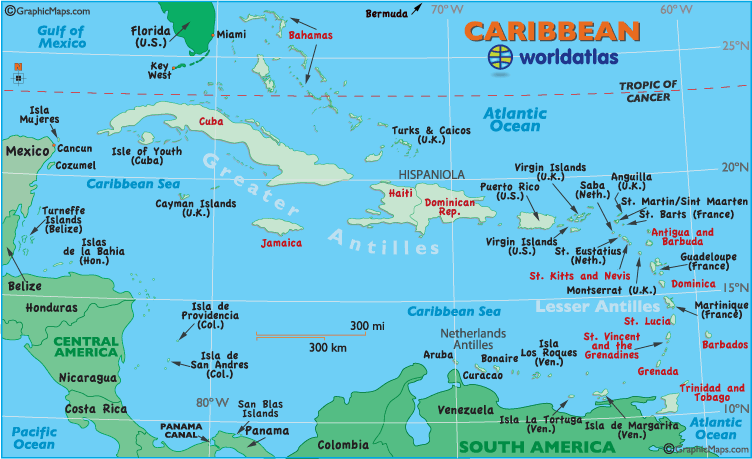

Caribbean Map, Caribbean Islands, Map of the Caribbean, West Indies Map

The Caribbean countries produce and export rum in large quantities to the U.S. and EU. The issue essentially pertains to the "cover-over" program wherein the U.S. provides refunds of excise tax collected on rum to the U.S. States producing it. A brief history of the cover-over program is provided by this Congress Research Service Report

Apart from the Caribbean countries, Puerto Rico (PR) and U.S. Virgin Islands (USVI) also produce rum which serves as competition to the rum produced in the Caribbean countries. The funds received by PR and USVI  in turn is being allegedly used to develop the rum industry and infrastructure in these U.S. States that adversely impacts rum producers in the non-US Caribbean countries. The  U.S. transfers 98% of the revenues collected on excise taxes imposed on rum sold in the US market to the Governments of Puerto Rico and the USVI. The programme does not provide any limitation as to how these two territories are to spend the transferred revenues. Until 2008, these funds were used for infrastructural development and welfare programmes by the Governments of the two territories. However, both territories are now said to be using some of these funds to finance activities aimed at the promotion and assistance of the local rum industry, to the detriment of rum producers established in these countries. 


The issue of the use of the funds for assisting the local rum industry has to be critically analyzed in the context of U.S. obligations under the ASCM Agreement. While use of the funds for general infrastructural development may be out of the purview of a WTO law  inconsistency, specific programs to promote and develop the rum industry may be suspect. Would it amount to a prohibited or actionable subsidy under ASCM? Would it violate the NT and MFN principles under GATT?

Cato explains the dispute lucidly here:
"The antagonist in this saga is something known as the “rum cover-over” program. As it does with all distilled spirits, the federal government charges an excise tax of $13.50 per proof gallon of rum sold in the United States. This equates to roughly $2 per bottle. Under the cover-over program, almost all of that money is directly granted to the U.S. Virgin Islands and the Commonwealth of Puerto Rico using a complex formula so that each receives a share of the money based on how much rum it produces relative to the other. The tax is collected from sales of all rum imported to the mainland, even from other countries, and in 2010 the cover-over amounted to approximately $450 million—$100 million to the Virgin Islands and $350 million to Puerto Rico. 
The industrial death spiral began when the government of the U.S. Virgin Islands cleverly discovered that, instead of using the money for infrastructure and welfare programs, it could use the bulk of the money to entice Captain Morgan producer Diageo to relocate there from Puerto Rico. Because the move will increase rum production in the U.S. Virgin Islands relative to Puerto Rico, the subsidy more than pays for itself by it helping the territory capture a larger share of cover-over funds."
Is the refund of excise taxes by the U.S. to PR and USVI and their subsequent use to promote the local rum industry in violation of U.S. obligations under the ASCM and GATT? The measures seem to have an adverse impact on the rum producers of other Caribbean countries and thus, as observers believe, amount to an actionable subsidy under WTO law. Will the Caribbean rum producing countries initiate a WTO dispute against the U.S.? Dominican republic, which has joined the Tobacco Plain Packaging dispute against Australia is likely to initiate this dispute against the U.S.

(Local Caribbean sugarcane growers)

The impact the U.S. measure has on local, small time producers of rum in the Caribbean countries is brought out by this commentary:
"While there is understanding of the economic problems facing the USVI, the reality is that the US Congress has allowed its USVI development program to divert hundreds of millions to primarily provide a development program for the largest distilled spirits companies in the world.  In this way the US is damaging one of the few competitive industries that Cariforum nations have and which helps underpin the economic viability of small and sometimes vulnerable Caribbean states.
... 
Rum has a special place in the hearts and minds of Caribbean people. It is a product that brings identity through small producers to the islands and countries of Cariforum from which it comes.  Unlike the product of large multinational distilling groups the success of Cariforum producers does not result from artificial tax breaks, transfer pricing or subsidy. Instead it is an industry dominated by small local distillers whose product is export oriented, brings much needed foreign exchange, adds value to primary agriculture and provides significant levels of tax and revenue to Governments struggling to deliver social programmes. 
That is why rum has always been a product worth fighting for, as Europe knows to its cost and the US is about to discover."
Will the Rum dispute go all the way to the WTO?