Showing posts with label GATT. Show all posts

Thursday, January 9, 2014

Public Morality as an exception - More shades of grey

Roger Alford has this brilliant piece in Opinio Juris on the scope and limitations of the "public morals" exception in Article XX(a) of the GATT contextualising it in the aftermath of the Seals dispute case. He rightly observes:
"Fifth, the public morals exception may become the new battleground for WTO litigation. Rather than consistently ignoring this exception and rushing to litigate Article XX(b) (protection of human, animal, or plant health or life) or Article XX(g) (protection of exhaustible natural resources), the new litigation strategy may be to identify how a trade restriction advances ethical concerns of the Member State. In the future, we may see IP piracy restrictions justified as a reflection of public concern about the morality of stealing, a carbon tax implemented out of moral concerns for the ethics of sustainable development, and restrictions on any number of Chinese products justified out of concern that Chinese workers are subjected to a mandatory one-child-per-family policy implemented through forced abortions. After EU–Seal Products the public morals argument is open for creative interpretation."
While the public moral exception can serve legitimate public concerns, can it become a tool for protectionist policies? Would it be used in the coming decade to justify import restrictions, including import bans of products made "immorally" or "unethically" from national standards? Though import bans seem less likely to be justified due to the inherently discriminatory nature of the measure since the local product is not prohibited, what if it is justified due to the nature of making the foreign product that is against a country's public morality"? Is there is possibility of "subjectivity" being justified in the garb of "objective" public morality? Will trade rules benefit or be a victim of this widely worded exception?

As in many other areas in international trade law, more shades of grey here than black or white.

Tuesday, February 26, 2013

EU and Japan also appeal - Ontario case becomes more interesting

I have blogged about the Canadian FiT case at the WTO case here, here and here. News of Canada appealing the matter was reported here. It was not surprising since Canada had lost the case and was contesting the finding of the panel report that it had violated the provisions of the TRIMS and GATT.

Reports of the EU and Japan cross-appealing caught my attention. This would presumably be mainly on the interpretation of the provisions of the ASCM, especially the definition of a subsidy and benefit.

It is clear that the Appellate Body would decide the legal contours of this dispute, especially the compatibility of local content requirements with WTO law in the context of governments guaranteeing a minimum feed in tariff. With a number of countries across the world, both developing and developed, having massive renewable energy support programs (many of them with local content requirements), the AB ruling all be keenly awaited. One hopes that going by timeframe of the Antigua and Airbus-Boeing cases at the WTO dispute settlement, the wait for a closure is not too long!

Thursday, February 14, 2013

Argentina, Spain and the battle over biofuels

I had earlier blogged about a WTO dispute between Argentina and Spain (DS443) over the Ministerial order pertaining to biofuels that was promulgated in Spain.The main thrust of the complaint was:
"The operative part of Ministerial Order (OM) IET/822/2012 provides that computing for mandatory biofuel targets may only be conducted in relation to biodiesel produced entirely in plants located on the territory of Spain or of another EU Member State, and in line with previously allocated volumes, in accordance with the procedure established in the same Ministerial Order. 
The Argentine Republic has since 2007 developed one of the most efficient biodiesel production sectors in the world and has now consolidated its position as the world's leading exporter of the product. The European Union is the main export market, and Spain is the main buyer on that market. In 2011, Argentine exports of biodiesel amounted to US$2.1 billion, with more than US$1.9 billion going to the EU and more than US$1 billion of the latter figure representing purchases by Spain. 
Ministerial Order (OM) IET/822/2012 and the implementation thereof would create discrimination between the product of European origin and that of other origins, implying a de facto prohibition on imports of biodiesel from outside the Community, for purposes of computing compliance with mandatory biofuel targets. This would totally exclude the Argentine product from the market. 
It is Argentina's understanding that the Spanish Ministerial Order and its implementation would in principle constitute an infringement of obligations, including, but not limited to, the obligations of that country and of the EU under Articles III:1, III:4, III:5 and XI:1 of the GATT 1994. Argentina also considers that the Order would be inconsistent with Articles 2.1 and 2.2 of the Agreement on Trade-Related Investment Measures (TRIMS), and with Article XVI:4 of the Marrakesh Agreement. Argentina considers that Ministerial Order (OM) IET/822/2012 would nullify or impair the benefits accruing to it under the covered agreements."
The legal challenge was as follows: 
"The key measure challenged by Argentina is the Spanish Ministerial Order regulating allocation of quantities of biodiesel needed to achieve the mandatory target of renewable energy.  This measure is the national implementation of the European Union regulatory framework for energy from renewable sources.  
Argentina claims that the Spanish measure is inconsistent with:
  • Articles III:1, III:4, III:5 and XI:1 of the GATT 1994
  • Articles 2.1 and 2.2 of the TRIMs Agreement; and
  • Article XVI:4 of the WTO Agreement."
News of Spain withdrawing the curbs on Argentinian biofuels was trickling in. Was it in response of the WTO complaint? Is this an example of the possible deterrent effect of the dispute settlement mechanism of the WTO? Do countries modify their national measures under the threat of a WTO action? Or is this more of a political move? In this case,on 6 December 2012, Argentina requested for the establishment of a panel. Will Argentina withdraw the WTO compliant now? With Spain having responded, many would say it is Argentina's turn to roll back some of its "protectionist" measures?

image 160 pixels wide


Sunday, February 10, 2013

Procurement by government, commercial resale and feed in tariff - Some interesting questions

Canada has decided to appeal against the Panel decision in the Ontario feed in tariff case. I had blogged about it here.

The notice of appeal is found here.Going by the contents, The main challenge is on the applicability of Article III:8(a) GATT to the facts of the case. Canada claims that it's measure is exempted under his provision and thus does not violate national treatment principle under GATT.
"Canada seeks review by the Appellate Body of the Panel’s findings and conclusion that the Government of Ontario’s FIT Program, as implemented through the FIT and MicroFIT Contracts, is not covered by the terms of Article III:8(a) of GATT 1994.This conclusion is in error and is based on erroneous findings on issues of law and legal interpretation including the Panel’s finding that the Government of Ontario purchases renewable electricity "with a view to commercial resale". 
Canada also requests the Appellate Body to find that the Panel acted inconsistently with Article 11 of the DSU by failing to make an objective assessment of the facts related to this issue, specifically with respect to the Panel’s finding that the resale of electricity purchased under the FIT Program is "commercial" in nature, and by using this faulty factual finding to support its conclusion about the applicability of Article III:8(a) of GATT 1994 to the FIT Program."
Article III:8(a) GATT states:
"The provisions of this Article shall not apply to laws, regulations or requirements governing the procurement by governmental agencies of products purchased for governmental purposes and not with a view to commercial resale or with a view to use in the production of goods for commercial sale."
The contours of this provisions would definitely be the subject matter of the AB proceedings. For an interesting debate on this subject see my comments on the IELP blog here. Would be interesting to see the AB interpreting "commercial resale" and other provisions of GATT. This would definitely have widespread implications for renewable energy support programs across the world. Another classic example of domestic policy space being impacted by international economic law and policy.


Saturday, February 9, 2013

U.S. challenges India's renewable energy program

It seems to be the week of renewable energy in international trade law circles with the United States requesting consultations with India in relation to domestic content requirements in India's national solar program.

The USTR carried this piece:
"United States Trade Representative Ron Kirk announced today that the United States has requested World Trade Organization (WTO) dispute settlement consultations with the Government of India concerning domestic content requirements in India’s national solar program. India’s program appears to discriminate against U.S. solar equipment by requiring solar energy producers to use Indian-manufactured solar cells and modules and by offering subsidies to those developers for using domestic equipment instead of imports. These forced localization requirements of India’s national solar program restrict India’s market to U.S. imports. Tackling these barriers is a top priority of the Obama Administration. 
... 
On January 11, 2010, India launched its national solar policy, the Jawaharlal Nehru National Solar Mission (JNNSM). Phase I of that national policy is composed of two parts: Batch 1 and Batch 2. Under Batch 1, India required developers of solar photovoltaic (“PV”) projects employing crystalline silicon technology to use solar modules manufactured in India. Subsequently, under Batch 2, India expanded this domestic sourcing requirement to crystalline silicon solar cells as well. In its draft policy for Phase II of the JNNSM, India has stated that it is considering expanding the scope of the domestic content requirements further to include solar thin film technologies, which currently comprise the majority of U.S. solar exports to India. India also offers solar energy developers participating in the JNNSM a guarantee that the government will purchase a certain amount of solar power at a highly subsidized tariff rate, provided that they use domestically manufactured solar equipment instead of imports. 
These elements of India’s national solar policy appear to be inconsistent with India’s obligations under the WTO agreements. These obligations include Article III of the General Agreement on Tariffs and Trade 1994 (GATT 1994), which generally prohibits measures that discriminate in favor of domestically produced goods versus imports; Article 2 of the WTO Agreement on Trade-Related Investment Measures, which prohibits trade-related investment measures that are inconsistent with GATT Article III; Article 3 of the WTO Agreement on Subsidies and Countervailing Measures (SCM Agreement), which prohibits conditioning a subsidy on the use of domestic over imported goods; and Article 5 of the SCM Agreement, which prohibits causing adverse effects on other WTO Members through subsidies that discriminate against imported goods."
The case has been widely reported herehere and here.With Canada appealing the feed in tariff case at the WTO (that came to a finding that domestic content requirements int he Ontario context were violative of Canada's obligations under TRIMS and GATT) and the US requesting for consultations on this issue, will 2013 be the year where renewable energy support programs around the world will be challenged at the dispute settlement mechanism?


Friday, February 8, 2013

Canada finally appeals in Feed in tariff case

As expected Canada has appealed against the Panel decision (DS412 and 426) in the Ontario Feed in tariff case. It has been reported here in the WTO website. The Panel had ruled against the local content requirement that was mandated by Canada's law and regulations in relation to feed in tariff.

I have blogged about this far reaching decision in the renewable energy sector here, here, here and here. Hopefully the Appellate Body (AB) would settle the complex issues of law in relation to the interpretation of a "subsidy" under the ASCM as well as whether local content requirements violate the "national treatment" principle both under the GATT and TRIMS. It would be interesting to see if the AB accepts the "minority" reasoning of the Panel with respect to conferment of a benefit under the ASCM? Countries with massive renewable energy support programs, especially feed in tariffs will be watching very closely.

Over to the AB now...


Thursday, February 7, 2013

Is economic nationalism and protectionism the same?

I have often written about the issues of protectionism, globalization and the role of the State in this blog here and here.Often, the role of the state and market are seen as mutually exclusive. Increasing globalization and integration of markets is seen as a natural corollary to the reducing influence and role of the State and government. However, is this analysis true? China is often taken as an example that defies this logic of increasing connectedness to the globalized market while retaining strong state presence. Is there a middle path where the role of the State and market and co-exit which is not antithetical to world trade rules? Is there a legitimate role for the state to play apart from being a facilitator and regulator? Is state intervention always protectionism? Can protectionism also exist in highly liberalized markets with other forms of State support?


Yale GlobalOnline has a refreshing piece by Anthony P. D’Costa on economic nationalism, role of the state and globalization. He essentially avers that the state can play a role of a promoter instead of being "protectionist" in a globalized world.He brands this as 'economic nationalism" wherein the State does not necessarily retreat but plays a more constructive role in promoting the welfare of its citizens.

"The concept of economic nationalism is used for selective engagement with the world economy. Rather than the orthodox notion of economic nationalism, defensive in nature and nation-centered, I offer a more dynamic understanding – economic nationalism in motion. This version, first proposed in theReview of International Political Economy, 2009, suggests that the practice is influenced by pragmatic considerations rather than ideology – akin to Deng Xiaoping’s proverbial cat that catches mice irrespective of its color – especially under fluid circumstances of economic growth, emerging competitive industries and, most importantly, as national capitalists mature. Earlier economic nationalism meant protection; today it’s promotion, though the basic motive for both is ensuring national economic interests. This ability to navigate changing circumstances and priorities pragmatically contributes to the dynamic movement of the practice of economic nationalism. 
Behind economic nationalism in motion is a particular kind of state-business nexus where the two operate in a public-private partnership. The key difference with this form is that the state explicitly promotes national capital at home and abroad for national economic gain, although prestige can also play a role, when a public-relations agenda drives hosting a major sports events or acquiring state- of-the-art technologies for pet projects without thorough cost-benefit analysis. 
Fostering national economic development and competitiveness, promoting national companies and brands, is part of the economic-nationalism-in-motion portfolio. Market-driven globalization is not incompatible with state intervention. States must identify the conditions under which such economic nationalism can be undertaken and the instruments at their disposal to negotiate the forces of economic globalization."
Thus, in this model all state intervention and promotion is not necessarily viewed as protectionism. Active state involvement to safeguard national interest, branding, promotion of national corporations (State Capitalists) are all part of this mission. Is this compatible with WTO rules? Is there anything in the GATT/WTO that prohibits this? Is this the middle path that emerging economies should undertake to negotiate globalization without abandoning it? However, there is a thin line between State involvement and control - and one must tread that line very carefully.


Monday, January 7, 2013

A currency dispute at the WTO in 2013?

Currency manipulation/undervaluation/misalignment has not yet attained centrality in WTO disputes or discussions except for a proposal made by Brazil at the WTO to take it seriously. There is abundance of legal literature, however, on the WTO compatibility of currency misalignment and the possible course of action under WTO law.The IELP blog  had a blogpost on it recently here. Does currency manipulation violate Article XV(4) GATT (frustrating the intent of GATT provisions) or is it a prohibited subsidy under the ASCM? I have written a paper on this which I will share soon.

The Peterson Institute for International Economics recently had a Policy Brief that highlighted the seriousness of the problem and recommended that a WTO case be brought against the major manipulators. the Policy brief titled "Currency Manipulation, the US Economy, and the Global Economic Order" gives an exhaustive account of what could constitute currency manipulation and contrary to popular belief that a few countries practice it there seems to be evidence that a large number of countries, both developing and developed, practice it.

 Recommending a WTO case, the brief highlights:
"We nevertheless believe that the status quo produces a gaping hole at the heart of the global economic order, that the bifurcation between the monetary and trading systems must be overcome, that the economic costs of inaction on this issue are extremely high during a prolonged period of slow growth and high unemployment such as the present and possibly the foreseeable future, and that multilateral remedies are highly preferable to unilateral actions. Hence we recommend that the United States and its allies bring WTO cases against the most egregious manipulators as part of a broader action program, all of whose other components would be at least arguably compatible with the existing international rules. If they won the case, it would strengthen their hands enormously in prosecuting all their other remedies and would, in a second WTO step to determine permissible remedial action, add to the arsenal of policy instruments available to them. If they lost, it would dramatize the need for reform of the WTO rules themselves and thus almost instantaneously place the issue on the agenda for either a future round or a stand-alone negotiation. Whatever the outcome, the coalition would have made every effort to use the existing rules and institutions and thus demonstrated its fealty to the international system."
While the legal arguments in favor of a WTO action in case of currency misalignment are not that sound, will 2013 see the first dispute settlement case where an undervalued currency is challenged on the grounds that it is violative of GATT or is a prohibited subsidy under the ASCM? Who will take the plunge?

Wednesday, November 28, 2012

Buy local?

"Buy local" seems to the the flavour now. It made news in France over demands of separate shelves in super markets selling French made goods while the U.S.Olympic national dress issue grabbed headlines for a few days. However both these were not "State measures" and hence were outside the purview of WTO provisions. An interesting discussion on this issue in the comments section of this IELP blogpost initiated by Marc Benitah made very interesting reading.

(Courtesy:vculevis.wordpress.com)

Ever wondered where your pair of jeans was manufactured? This blogpost from the American Federation of Labor and Congress of Industrial Organizations (AFL-CIO) espouses the cause of "buy American" to boost the American economy and jobs. 
"Buying American isn’t just an antiquated idea. Our future as a nation depends on reviving our economy to create good jobs that allow those who put in a fair day’s work to receive a fair day’s pay: to raise families and send the next generation to college. By supporting American manufacturers, we can all do our part to be America’s real job creators. For more ideas on reviving the American economy, go to www.aflcio.org/Issues/Jobs-and-Economy/Economy."
They make the point that a strong industrial base and buying local was always part of the U.S. growth story and one should encourage buying local in housing, food and clothing. Three websites of "buy American" emphasize the point of the advantages of buying local as compared to imported goods - Still Made in USA.com, howtobuyamerican.com and usonly.us 

Now, this is not an executive of the State and hence would not amount to a "State measure" which can be challenged at the WTO. However, the intent of making a choice between local and imported goods is clearly there. It is an exhortation to people to be "patriotic" and buy local and shun imported goods. Wonder what the free traders would have to say to this? Is there a middle path here? Local for some products, international for others, perhaps?


Wednesday, November 21, 2012

Ukraine, tariff and domestic policy space

I have blogged about Ukraine's tryst with the world trading system in the context of the Australian Tobacco Plain Packaging legislation challenge here. KyivPost recently reported that the Ukrainian Parliament has decided to raise the import tariffs to the maximum level of bound tariffs under the multilateral trade rules.
"The Ukrainian parliament is to increase the import duty rates for around 100 commodities to the maximum level agreed by Ukraine and the World Trade Organization (WTO) from January 1, 2013."
Ukraine has also been in the news for the use of GATT Article XXVIII tariff renegotiation. Is this latest step of increasing tariff rates to the bound levels a sign of protectionism or exercise of domestic policy space? 


Monday, October 29, 2012

Employment, Dominican republic and Tobacco Plain packaging

(Cigarette manufacturing in the Dominican Republic)

The Dominican Republic is one of the complainants along with Ukraine and Honduras against the Tobacco Plain Packaging legislation of Australia. This piece in the Dominican Today about the dispute highlights the centrality of tobacco manufacturing in the Dominican Republic:
"While tobacco has been cultivated in the Dominican Republic for more than five centuries, the Dominican tobacco industry is a hundred years old. Tobacco export revenues represent roughly 8% of total exports in merchandise. The Dominican Republic is the largest net exporter of cigars in the world. Tobacco products represent 8.5% of fiscal revenue on merchandise taxation. There are around 5,500 tobacco producers, employing approximately 55,000 agricultural workers. Tobacco manufacturing employs another 63,000 people, of which 60 percent are women. Combined with the entire tobacco production chain, the industry thus generates around direct 118,000 jobs which supports approximately 350,000 people, according to information published by the Tobacco Institute of the Dominican Republic."
Thus, tobacco manufacturing and export is one of the main industries here as well as employment generator. It supports families and gives employment to a large number of women. Is this irrelevant in a dispute international trade law? If the Australian legislation, which is an exercise of its domestic policy space, is held to be compatible with WTO law (GATT, TBT and TRIPS), is the question of employment and job creation irrelevant to the issue. This is another classic case of the "loser" in globalization. An industry which was thriving can be possibly hurt by measures taken by other countries which may not be incompatible with international trade law. Those employed in these industries constitute a domestic constituency. How does the politics of domestic interests play out in international trade relations? While Dominican Republic's domestic will to engage in the trade is not impacted per se, the Australian measure does impact it in a negative way. Do considerations such as employment potential figure in the debate at all?

Wednesday, October 24, 2012

Buy French - Rumblings of protectionism in the EU?

I have blogged about the issue of protectionism consistently whether by the developed world or enveloping countries. The trend is increasing across the globe due to a variety of factors and in various forms. This piece related to the history of the "protectionist" ethos in France.

Reuters recently reported that a French Minister had announced that consumers must encourage buying local French products. Simon Lester, in his inimitable way, has highlighted this at the IELP blog here.

Favouring domestic goods in comparison to imported goods is a clear violation of GATT non-discrimination provisions. However, whether this is a mere statement/intent/pronouncement  or is a clear enunciation of policy is unclear. If it is a statute/regulation/policy a WTO member could challenge France at the WTO. However, if it is only a case of political rhetoric or opinion, there is nothing much anyone can do.

Rumblings of protectionism in the EU?


Tuesday, October 23, 2012

Culture, human rights and the WTO

Tania Voon has written an interesting piece on the intersection of cultural values, human rights and WTO in this piece. Human rights does not normally figure in the discussion in international trade law and policy. The international law discourse on human rights having its basis in the UN Charter is seen more as a political discourse not finding its way in the international economic law and policy domain.

Tania Voon analyses WTO disputes pertaining to audiovisuals and food related risks and raises important issues of the role of cultural preferences in WTO jurisprudence. She concludes:
"The limited reflection on human rights within the WTO and the reluctance by many Members to introduce non-WTO public international law into the WTO legal framework (whether implicitly or explicitly) may help explain why WTO Members are having such difficulty in agreeing on how to treat subject matters related to culture such as traditional knowledge and genetic resources in the current negotiations. The failure to reach agreement in the Uruguay Round (or subsequently) on the proper approach to audiovisual products and printed publications may also make Members wary of opening discussions premised on culture or human rights in a general sense. Instead, Members may find themselves focused on technicalities such as the modalities of negotiation and the wording of minor amendments to the existing agreements, even where broader principles (such as adherence to the general objectives of the CBD) are agreed. However, the pragmatic acceptance of a wide range of perspectives on culture and its relationship to trade in the WTO has in some ways been beneficial. Culture is properly a secondary consideration in the formulation of many WTO rules, including some that might appear directly related to culture but that actually have different purposes, such as geographical indications. A healthy disagreement among WTO Members about the relationship between the WTO, culture and human rights may assist in keeping the rules under close examination and encouraging greater contemplation of that relationship within the organisation in future."
Article XX General Exceptions dealing with public morals would come the closest to giving flexibility to WTO members to engage with the multilateral system keeping in mind their cultural context. The issue of a particular WTO member's cultural context intersecting with international trade rules is in two ways;

1. When a country exercises its domestic regulatory choice based on its cultural context, it can be challenged in the WTO as being protectionist or unreasonably restrictive. The debate then revolves around whether a country has domestic regulatory space to pursue its cultural values.

2. When a country's products are impacted by a measure of another WTO member on the grounds of "cultural values", it impacts international trade and can be a "protectionist" tool by certain countries to protect domestic industry.

Thus, the adoption of values of human rights, labour rights, cultural mores in international trade law must be viewed with a bit of caution keeping in mind the issue of these measures becoming defacto non tariff barriers. In what circumstances they are permitted and to what extent they can limit free flow of goods across borders is a contentious one. It involves at times a threadbare interpretation of the  The political economy of the use of cultural rights to further one's national interest is a genuine threat.However, the need to engage in identifying the intersection is nevertheless necessary.


Wednesday, October 17, 2012

Ontario Feed in Tariff - Not a prohibited subsidy but violative of GATT provisions?


Breaking news of an interim WTO panel ruling on the Ontario Feed in Tariff case is coming in. The Globe and Mail reported it here. The EU and Japan had challenged the FiT program for renewable energy of Ontario which mandated use of locally manufactured Ontario products on the grounds that it violated the "local content" rules of the ASCM, TRIMS and GATT. I had earlier blogged about it here, here and here.

The WTO website has no official confirmation of the interim decision (the website is normally uptodate on decisions and happenings in the WTO). ICTSD has a detailed note on the interim decision:
"According to a confidential interim WTO dispute settlement report, a three-member panel has sided with the EU and Japan in their challenge of renewable energy support provided by the Canadian province of Ontario, sources told BioRes this week. The two countries had argued that the feed-in-tariff (FIT) system - put in place in 2009 - violates WTO rules because it requires participating electricity generators to source up to 60 percent of their equipment in Ontario. 
According to a confidential interim WTO dispute settlement report, a three-member panel has sided with the EU and Japan in their challenge of renewable energy support provided by the Canadian province of Ontario, sources told BioRes this week. The two countries had argued that the feed-in-tariff (FIT) system - put in place in 2009 - violates WTO rules because it requires participating electricity generators to source up to 60 percent of their equipment in Ontario .However, based on what is currently known about the confidential document, assertions by Brussels and Tokyo that the programme also amounted to illegal subsidies - dependent on use of locally produced equipment - have been rejected. At the time BioRes went to press, the ruling was not available."
If I understand this right, the panel has decided that the local content requirements are violative of WTO obligations of non-discrimination under GATT and TRIMS. However, they do not constitute a "prohibited subsidy" under Article 3 (1) (b) of the ASCM. Does this imply that an FiT as implemented in Ontario is not a subsidy as defined by the ASCM and hence does not amount to a "prohibited" subsidy? Or does it not have the characteristics of a prohibited subsidy as defined under Article 3 of the ASCM? The other major implication of this distinction of not amounting to a prohibited subsidy is the applicability of the general exception of Article XX of GATT. If it was declared a prohibited subsidy it would have been more difficult for Canada to justify its measure under Article XX of the GATT. This distinction has a major implication for renewable energy programs, especially FiTs, worldwide.

WIll eagerly await the November panel ruling.


Friday, September 14, 2012

Law and Economics at the WTO - A tense but necessary relationship

I have blogged about the relationship of economics and law in the interpretation of international trade law here and here. What is the relevance of economic principles, complex econometric models and economic analysis in WTO litigation. As lawyers one tends to ignore or sidetrack principles of economics while interpreting legal provisions.

Joost Pauwelyn in this piece titled "The Use, Nonuse and Abuse of Economics in WTO and Investor-­State Dispute Settlement" has a brilliant exposition of the complex relationship between economics and the law especially in relation to WTO litigation and Investor-State disputes. It traces the tense relationship, possible areas of application and the caveats required to have a meaningful combination.

Especially in relation to WTO disputes, the author states that the increasing use of economics is found in the determination of "like products", an analysis of "less favorable" treatment under various Agreements, definition and impact of "subsidies" as required by the ASCM, interpretation of the ever expanding "general exceptions" clause under Article XX of the GATT. he also prescribes some caveats in the unbridled use of economic principles like economics must be filtered through legal criteria, methodological discipline, for communication purposes, ‘keep it simple’, due process and avoiding or disclose value judgments.

He concludes with these words:
“Legal certainty and economic principles are not substitutes but complements”.100 Economics has a role in WTO and investor-­‐state dispute settlement. Economics provides insights not only in lawmaking but also in law application, both fact establishment and legal interpretation. The influence of economic evidence and arguments, including quantitative studies, is on the rise in both fields (in contrast to, for example, the practice of the International Court of Justice). It spans far beyond damage calculations and decisions on appropriate trade retaliation. In the WTO: like products (where quantitative studies could be used more prominently), less favorable treatment (where a tension is emerging between “detrimental impact” which must be shown, and “actual trade effects” which are not required), subsidies (e.g. assessing anticipated export shares for de facto export contingency or ex post serious prejudice for actionable subsidies) and general exceptions. In investor-­‐state arbitration: economic necessity (where the infamous Enron award was annulled for being based on economics rather than law). And in both regimes many more provisions lend themselves to input from economics. For example, in the WTO: causation and exceptions; in investment: definition of investment, fair and equitable treatment. Such input can provide more robust, empirically sound and predictable outcomes and better connect trade and investment law to the ‘real world’. It improves the output and effectiveness of both litigating parties and adjudicators. This, in turn, can broaden the support and legitimacy of both the trade and investment regimes. 
At the same time, reliance on economics does not come without risks. “Economic evidence is a powerful but also a dangerous tool”. Core caveats and limits are: (1) at least in litigation, economics must be filtered through legal criteria; (2) methodological discipline, to be respected by both the parties and the adjudicator (to avoid collective action problems, these disciplines must be imposed ex ante on both parties, which is not the case today); (3) for communication purposes, ‘keep it simple’; (4) due process (e.g. in respect of input by WTO staff economists; the independence and cross-­‐examination of party-­‐appointed experts; and participation of poor countries or small investors); and (5) avoid or disclose value judgments. The cases and controversies discussed in this contribution indicate the progress made on all five scores but highlight that a lot of work must still be done to conform to ‘best practices’. Appropriate use of economics surely tops nonuse. At the same time, given the risks involved, nonuse may eventually be wiser than misuse or abuse." 
The theme of the relationship between law and economics has a long standing one, especially in the context of trade law. Economics and its quantitative analysis has a bearing on judicial interpretation. Infact, this blog has a rich source list of blogs that believe in this inextricable relationship - Law and Economics and The Becker-Posner blog. What does this mean for litigation and negotiation at the WTO - more interdisciplinary teams of trade lawyers, economic experts to handle such complex situations. The question perhaps is not whether law or economics should prevail - the issue is how each could supplement the other in understanding realities of trade and business.


Tuesday, September 4, 2012

Illegal timber logging - Australia's law is shaping up


I had earlier blogged about a proposed Australian legislation dealing with illegal timber logging titled the "Illegal Timber Logging Prohibition Bill 2011" which was passed by the lower house of the Australian parliament a few days back and has reached the Senate. An anonymous comment to this blogpost brought me back to this topic.

Does the Bill treat imported timber less favorably than local timber products? Is it more onerous for imported timber products to establish legality than local like products? Even if the legislation does not de jury discriminate between imported and local products on terms of applying equally to both products, is there a de facto discrimination since there is a greater probability of "illegal" timber coming from certain countries than others? Does the legislation modify the conditions of competition for imported timber products and is thus discriminatory and in violation of the national treatment principle under GATT? What are the contours of the Article XX general exceptions GATT in the present dispute? Do they justify the measure?

A recent study by Duncan Brack on the compatibility of the proposed Australian legislation with WTO law seemed to suggest that Article XX would save the legislation.The longer version of the study is found here.
"It is impossible to know precisely how the proposals in the Australian legislation relate to these WTO rules, as the details of the proposals are not yet finalised. In particular, we do not know exactly which products will fall into the category of “regulated timber products” for the purpose of the due diligence requirements, or many of the details of those requirements themselves - including, importantly, which legality verification, forest certification, or other existing or evolving systems for identifying legality are likely to be regarded as placing their products into low-risk categories. 
However, as long as the basic WTO principle of non-discrimination is respected - as reflected in Article XX(g) and the headnote to Article XX - it seems likely that Article XX(g) of the GATT could provide a justification for trade-restrictive measures aimed at excluding illegal timber from international trade, should a WTO dispute ever be brought. The main arguments against this position, as expressed in one of the submissions to the Senate Committee inquiry, seemed to rest on the assumption that any products that enter trade must be treated in the same way, regardless of their status under national laws (i.e., that legal and illegal timber are “like products”). Taken to its logical conclusion, this would require all countries to have exactly the same laws - which seems likely to be a misreading of the GATT."
Commenting on this article, Lorand Bartels feels that the interpretation of the general exception under Article XX GATT would be the focal point of a challenge and its defense:
"... More promising is the notion that there is a ‘nexus’ between logging and Australia in terms of climate change. In my view, the territorial scope of Art XX GATT should be assessed in terms of the rules on public international law on legislative jurisdiction. It might be argued, along these lines, that Australia has a right to regulate activities abroad (ie logging) in order to mitigate the effects of climate change on its own territory. (From your summary, it does not appear that Australia is also regulating the domestic marketing of such products, which would add a basis for territorial regulation).

But even so, what about the facts? To what extent can this measure be justified in terms of climate change? And what does ‘legality’ have to do with it? Is this connected with climate change? In short, is there really a causal link between the measure and this objective?"
Increasingly, national measures would not be blatantly discriminatory. The intent and the impact of the measures would have to be considered. Do they have a de facto impact on adversely affecting imported products? Are they designed to discriminate between imported and local products? Are the conditions so onerous that it is more likely that imported products, from less developing countries, will be impacted?

While the measure itself would apply to both imported and local products in actuality the impact on the trade on imported goods would be so high that it could amount to a discrimination. Another ground for a challenge, inspite of the defense of Article XX, could be the non-fulfilment of the chapeau requirements. Does it constitute a means of arbitrary or unjustifiable discrimination between countries where the same conditions prevail, or a disguised restriction on international trade? Would the imports of Indonesian timber be adversely affected by the legislation? Is more illegal timber logged in Indonesia or would it be difficult to comply with the conditions of due diligence that the legislation demands? WIll Indonesian timber become less competitive and more expensive if the conditions mandated are complied with? Will it lose its competitive edge?

One would have to wait for the legislation to be passed and a possible Indonesian challenge at the WTO for some of these questions to be answered. Till then, timber logging would remain an uncontested topic in WTO dispute settlement.


Friday, August 3, 2012

Of Rum and a WTO dispute


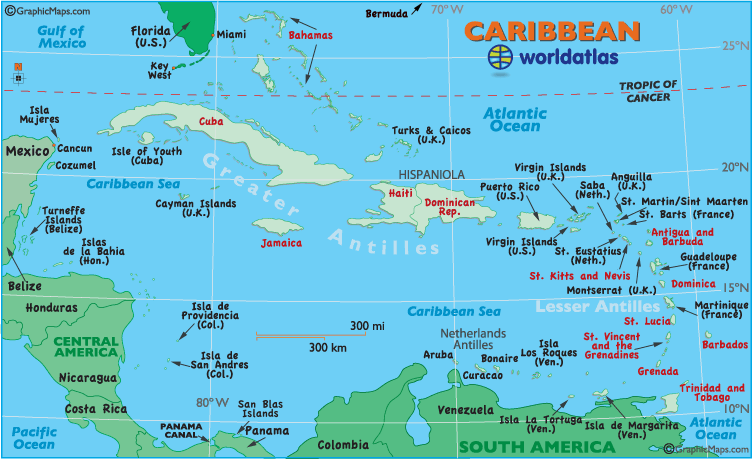
Rum and a WTO dispute? This looks plausible with the Caribbean countries raising the issue of "subsidization" of the rum industry in the U.S. The issue was widely reported here, here and here. The Caribbean countries are the 13 island countries in the Caribbean sea which includes Antigua, Dominican Republic and Haiti.


Caribbean Map, Caribbean Islands, Map of the Caribbean, West Indies Map

The Caribbean countries produce and export rum in large quantities to the U.S. and EU. The issue essentially pertains to the "cover-over" program wherein the U.S. provides refunds of excise tax collected on rum to the U.S. States producing it. A brief history of the cover-over program is provided by this Congress Research Service Report

Apart from the Caribbean countries, Puerto Rico (PR) and U.S. Virgin Islands (USVI) also produce rum which serves as competition to the rum produced in the Caribbean countries. The funds received by PR and USVI  in turn is being allegedly used to develop the rum industry and infrastructure in these U.S. States that adversely impacts rum producers in the non-US Caribbean countries. The  U.S. transfers 98% of the revenues collected on excise taxes imposed on rum sold in the US market to the Governments of Puerto Rico and the USVI. The programme does not provide any limitation as to how these two territories are to spend the transferred revenues. Until 2008, these funds were used for infrastructural development and welfare programmes by the Governments of the two territories. However, both territories are now said to be using some of these funds to finance activities aimed at the promotion and assistance of the local rum industry, to the detriment of rum producers established in these countries. 


The issue of the use of the funds for assisting the local rum industry has to be critically analyzed in the context of U.S. obligations under the ASCM Agreement. While use of the funds for general infrastructural development may be out of the purview of a WTO law  inconsistency, specific programs to promote and develop the rum industry may be suspect. Would it amount to a prohibited or actionable subsidy under ASCM? Would it violate the NT and MFN principles under GATT?

Cato explains the dispute lucidly here:
"The antagonist in this saga is something known as the “rum cover-over” program. As it does with all distilled spirits, the federal government charges an excise tax of $13.50 per proof gallon of rum sold in the United States. This equates to roughly $2 per bottle. Under the cover-over program, almost all of that money is directly granted to the U.S. Virgin Islands and the Commonwealth of Puerto Rico using a complex formula so that each receives a share of the money based on how much rum it produces relative to the other. The tax is collected from sales of all rum imported to the mainland, even from other countries, and in 2010 the cover-over amounted to approximately $450 million—$100 million to the Virgin Islands and $350 million to Puerto Rico. 
The industrial death spiral began when the government of the U.S. Virgin Islands cleverly discovered that, instead of using the money for infrastructure and welfare programs, it could use the bulk of the money to entice Captain Morgan producer Diageo to relocate there from Puerto Rico. Because the move will increase rum production in the U.S. Virgin Islands relative to Puerto Rico, the subsidy more than pays for itself by it helping the territory capture a larger share of cover-over funds."
Is the refund of excise taxes by the U.S. to PR and USVI and their subsequent use to promote the local rum industry in violation of U.S. obligations under the ASCM and GATT? The measures seem to have an adverse impact on the rum producers of other Caribbean countries and thus, as observers believe, amount to an actionable subsidy under WTO law. Will the Caribbean rum producing countries initiate a WTO dispute against the U.S.? Dominican republic, which has joined the Tobacco Plain Packaging dispute against Australia is likely to initiate this dispute against the U.S.

(Local Caribbean sugarcane growers)

The impact the U.S. measure has on local, small time producers of rum in the Caribbean countries is brought out by this commentary:
"While there is understanding of the economic problems facing the USVI, the reality is that the US Congress has allowed its USVI development program to divert hundreds of millions to primarily provide a development program for the largest distilled spirits companies in the world.  In this way the US is damaging one of the few competitive industries that Cariforum nations have and which helps underpin the economic viability of small and sometimes vulnerable Caribbean states.
... 
Rum has a special place in the hearts and minds of Caribbean people. It is a product that brings identity through small producers to the islands and countries of Cariforum from which it comes.  Unlike the product of large multinational distilling groups the success of Cariforum producers does not result from artificial tax breaks, transfer pricing or subsidy. Instead it is an industry dominated by small local distillers whose product is export oriented, brings much needed foreign exchange, adds value to primary agriculture and provides significant levels of tax and revenue to Governments struggling to deliver social programmes. 
That is why rum has always been a product worth fighting for, as Europe knows to its cost and the US is about to discover."
Will the Rum dispute go all the way to the WTO? 


Wednesday, July 4, 2012

Security interests, WTO and domestic policy space

The question of the balance between domestic policy space and following multlilateral treaty obligations has often been a topic in my blog. An article titled "The Self-Judging WTO Security Exception" by Roger Paul Alford in the Utah Law Review on the use of the 'Security exception" under GATT which explores this debate in the context of Artice XXI of GATT in great detail provides a brilliant overview of the issue. To what extent does Article XXI give a country the freedom to impose restrictions that hinder free trade? Is it an unrestricted right? Is it "self-judging" or based on objective criteria? Who decides (the member country or the Dispute Settlement Body) as to the necessity and desirability of the measure? Is the exception open to abuse? What has been the practice of countries in this regard? Can the threat of a "national security" issue be misused as a protectionist tool? Can it be used to pursue an ideological agenda in international relations?

Article XXI of the GATT states:
"Security Exceptions 
          Nothing in this Agreement shall be construed
(a)      to require any contracting party to furnish any information the disclosure of which it considers contrary to its essential security interests; or
(b)      to prevent any contracting party from taking any action which it considers necessary for the protection of its essential security interests
(i)       relating to fissionable materials or the materials from which they are derived;
(ii)      relating to the traffic in arms, ammunition and implements of war and to such traffic in other goods and materials as is carried on directly or indirectly for the purpose of supplying a military establishment;
(iii)     taken in time of war or other emergency in international relations; or
(c)      to prevent any contracting party from taking any action in pursuance of its obligations under the United Nations Charter for the maintenance of international peace and security."
The provision itself provides wide latitude to a member to take measures inconsistent with WTO obligations "which it considers" necessary for the protection of its essential security interests. The article makes a detailed analysis of the use of this provision and its challenge at the DSM of the WTO. Contrary to fears of its possible abuse and extensive use, State practice indicates that it has not been invoked too often. Further it has never been a subject of a WTO dispute though many countries could have justified some of their measures under this exception. The author asks some pertinent questions regarding the lack of abuse of this provision:
"The general and consistent practice of complying with a self-judging rule raises larger issues beyond the WTO. While the self-judging nature of Article XXI remains contested, it is undeniable that it has been invoked at the sole discretion of the Member States. As such, it provides a useful prism through which to consider theories of international law compliance. Unlike almost every other aspect of the WTO, there is no obvious sanction for ignoring its textual limits. So why does a State typically invoke Article XXI(b)(ii) to restrict military and dual-use goods, but not purely civilian products? Why does a State not declare virtually every crisis—economic, political, social, or military—an “emergency in international relations” under Article XXI(b)(iii)? Why does a State not consider virtually any national policy an “essential security interest”? With billions of dollars at stake in WTO litigation,350 why not invoke the security exception in bad faith? In short, what is to prevent Article XXI from becoming the exception that swallows the rule?"
Explaining the various theories of compliance to international law and its juxtaposition to the limited use of the security exception the article tends to view that the exception to be not abused in good faith. 
" The WTO security exception carries forward Adam Smith’s great insight: defense is more important than free trade. The security exception is an anomaly, a unique provision in international trade law that grants the Member States freedom to avoid trade rules to protect national security. In the long history of GATT and the short history of the WTO, that freedom has never been challenged seriously. Member States understand the exception to be self-judging, and presume that it will be exercised with wisdom and in good faith.
Thus far, the record has been impressive. While no doubt there have been departures, the self-judging security exception has worked reasonably well. It certainly has not undermined the effective functioning of the WTO. The overwhelming majority of security measures are unregulated by international trade law, and those few that have been challenged were never reviewed. International trade law, viewed by many as the most effective and intrusive branch of international law, has preserved one enclave of complete national sovereignty. There are many possible explanations for its success. Its ambit is sufficiently broad to cover most security concerns, and it is reinforced by other WTO provisions that facilitate compliance.
A self-judging rule that Member States honor provides helpful insights into broader questions regarding nations obeying other international laws. Any number of theories, including traditional normative theories of compliance, and more controversial rational choice theories that focus on national self-interest, can explain the strong compliance record. The one theory that has little explanatory power is a pure coercion theory. Whatever may be motivating Member States to respect the limits of the security exception, it is not fear of sanction."
A recent example of a ban on exports due to a possible security exception was seen in the case of the EU ban on exports of luxury items to Syria about which I have blogged here. Is the fact that the security exception has not been misused so far by any country to advance protectionist measures is in itself a guarantee for the future? With the trend of increased protectionist measures, is there a danger that this provision will be open to "innovative" interpretation to justify countries' measures? Does "essential security interests" include "economic interests" ? Who defines what the contours of this "economic interest' is? Are there objective criteria to do so? Is the exception "self judging" or subject to DSM judicial review? To what extent can the judicial review question the rationale of a domestic policy choice? Would an over authoritative judicial body undermine compliance? Would it be reasonable to argue that it is in a countries economic interest to protect its domestic industry? Only time will tell if this exception becomes the rule?