Showing posts with label disputes. Show all posts

Thursday, November 28, 2013

More litigation practise

Talking about litigation practice, it seems Indonesia has filed another case. This time it is against Pakistan over anti-dumping measures taken by it against writing and printing paper from Indonesia. The case (DS470) is reported here.

Talking about WTO disputes, the big one this week was the Seals dispute between Norway and EU that I have  blogged about here earlier. 
The panel concluded that the IC exception under the EU Seal Regime violates Article I:1 of the GATT 1994 because an advantage granted by the European Union to seal products originating in Greenland (specifically, its Inuit population) is not accorded immediately and unconditionally to the like products originating in Norway. With respect to the MRM exception, the panel found that it violates Article III:4 of the GATT 1994 because it accords imported seal products treatment less favourable than that accorded to like domestic seal products. The panel also found that the IC exception and the MRM exception are not justified under Article XX(a) of the GATT 1994 (“necessary to protect public morals”) because they fail to meet the requirements under the chapeau of Article XX (“not applied in a manner that would constitute arbitrary or unjustified discrimination where the same conditions prevail or a disguised restriction on international trade”). The panel additionally found that the European Union failed to make a prima facie case that the EU Seal Regime is justified under Article XX(b) of the GATT 1994 (“necessary to protect … animal … life or health”).
Need to get down to reading the Panel report and commenting on it soon.

Monday, October 14, 2013

WTO disputes, trade and strategic litigation?

An interesting link between WTO disputes and the growth of trade is analysed in a paper titled "Do WTO disputes actually increase trade?". The paper finds:
"We find that WTO disputes do not, on average, increase a country’s imports of the products at issue. We find only very specific effects of disputes based on the dispute outcome and issue-area. We find significant variation across countries in their responsiveness to disputes, yet that most common explanations cannot account for this variation. This article highlights and begins to fill a significant gap in our understanding of the purpose of the WTO and its effects on trade."
The paper concludes:
"This paper presents an important finding: the effect of WTO disputes on imports at issue is, at best, inconsistent. In the aggregate, disputes are not associated with a statistically significant increase in imports. Looking at particular dispute outcomes and issue areas, only certain types of disputes have been associated with increased trade, and many have resulted in decreases. More- over, certain respondents are more “responsive” to disputes than others. Disputes against some countries have resulted in increased imports, while disputes against others have failed to do so. We do not find strong evidence of a systematic explanation for this variation."
While the relationship between a dispute and the impact it has on trade is far more complex, I found two reasons noted in the paper as to why countries probably file WTO cases interesting - rule clarifying and setting precedence for one's advantage.
"It may be, for instance, that the benefit of dispute settlement rests entirely on its rule-clarifying function. In such a telling, a dispute’s resolution leads to a convergence of expectations over country behavior. If we are to believe that most noncompliance amounts to a misunderstanding of the meaning of rules (Chayes and Chayes, 1993), the main benefit of a dispute may be to clarify the meaning of the underlying law. This benefit would be felt throughout the institution, as countries adjust their behavior to take into account that, e.g. the use of safeguards is now known to require the demonstration of “unforeseen developments”.If this is the case, however, our null finding over the effect on trade of mutually agreed solutions is of special concern. Indeed, settlements have no clarifying effect, since their content is usually kept largely private. When taken together with the finding that settlements have no average effect on trade, there remains little to recommend settlements. This is especially striking given the literature’s contention that MAS are where most of the action occurs in dispute settlement. 
Related to the idea of rule-clarification, it could be that dispute settlement is mostly an exercise in changing the meaning of the rules to one’s advantage. Perhaps countries file to set favorable precedents about matters of concern to them. Although the WTO features no formally binding precedent, or stare decisis, scholars largely agree that something akin to de facto stare decisis actually takes place (Bhala, 1998), where rulings do constrain the rulings of judges in subsequent cases. .."
Strategic litigation? 

Sunday, February 24, 2013

WTO dispute settlement and China-US trading relations

The dispute settlement mechanism of the WTO has been hailed as the crown jewel of the multilateral system providing an avenue for trading partners to resolve intricate and complex trade disputes within a rule based system. It is often compared to the more 'political' power based negotiation process wherein relative economic strengths and other factors influence decision making.

A good insight into China-US trading relations in the context of their disputes at the WTO is found in this piece by Ka Zeng which essentially argues how the dispute settlement mechanism of the WTO has averted any major trade war between the two trading superpowers.It has also been used by both the countries effectively to pursue their national interests.
"All this suggests that the WTO DSM has become the primary means for handling politically salient issues for both countries.  If this is the case, the growing utilization of the DSM in the past decade may have helped to channel the tensions surrounding the bilateral trade relationship and prevented intense interest group pressure from impairing overall U.S.-China trade relations. In the absence of the DSM, it is possible that major bilateral trade disputes resulting from China’s ever-growing trade surplus with the U.S. and allegations of the undervaluation of the Chinese currency could have generated far more acrimony and tensions in bilateral economic relations."
Her full article on this interesting aspect of China-U.S trading relations is found here


Tuesday, January 1, 2013

International Trade Lawyers - More fun in 2013!

Reuters reported recently that the WTO is bracing itself for the surge in trade disputes in its dispute settlement mechanism. 2013 is going to see an increase in trade disputes.
"A surge in trade disputes has forced the World Trade organization to reallocate staff to cope with a flood of litigation in the pipeline for 2013, according to diplomats and documents at the global trade body in Geneva. 
The WTO's 157 members have launched 26 trade disputes so far in 2012, the most since 2003 and three times more than the eight new complaints filed in 2011. 
According to an internal WTO document seen by Reuters, the WTO decided to reallocate staff to the disputes team to deal with the increasing number and complexity of legal cases."
The increase in trade disputes points out to a number of conclusions:

1. The faith WTO members repose int he rule-based dispute settlement process - the "crown jewel" of the WTO system. This reliance is also causing a strain on the system with the WTO apparently having to reallocate staff to meet the growing dispute count.

2.Negotiations are moving at a slow pace with Doha tottering. Political negotiations and judicial dispute resolution are two facets of the multilateral institution. If one fails to progress, the other is burdened with the responsibility of tackling many of the issues international trade faces. Hence, experts argue that the dispute settlement mechanism is facing the heat due to the failed Doha round. There has to be a safety valve somewhere. Whether it addresses the new reality of trade, including global supply chains and RTAs is another issue.

3. Countries are increasingly using the dispute settlement process as part of an overall national strategy to engage with the multilateral system. They do not view it just as a judicial process. National policies are defended here and policies of other countries that impact market access of a country's products are challenged here. A trade dispute is no longer viewed as a trade war. It is increasingly being used as a tool in the overall trade policy strategy of a country engaging in the multilateral system.

Legal capacity, technical expertise and a diverse team of lawyers, trade policy analysts and economists need to come together in handling a dispute. Some disputes are extremely complex matters involving the use of econometric models and trade statistics. Also, some of these disputes (like the Canadian FiT case, Airbus-Boeing Subsidies case) are going to have a lasting impact on the renewable energy sector.

Overall, 2013 is going to be fun for International Trade Lawyers worldwide.


Wednesday, December 19, 2012

Russia and WTO - new challenges

Russia's entry into the WTO has been heralded as a major event in the world trading regime's history. I have blogged extensively on Russia's entry here, here and here.

While Russia is settling down in its new position in the multilateral trading institution, its trading partners are getting a little impatient it seems. Reports of the EU being unhappy with certain restrictions placed by Russia in the automobile sector, exports of live animals and other goods.

Reuters commented on the issue thus:
"Russia joined the WTO this year after a 19-year wait and Putin has said the country would use its membership to develop worldwide trade links. 
But he said in November the country's $1.9 trillion (1.17 trillion pounds) economy could suffer from WTO entry due to the increase in imports that would result. 
Russia's team at the WTO is not fully up and running, something which may be delaying an EU decision to launch a case at the global body."

The Russian Team - Case for the strengthening of the legal capacity of the Russian Federation to meet these challenges? It is just the beginning. 

Friday, October 12, 2012

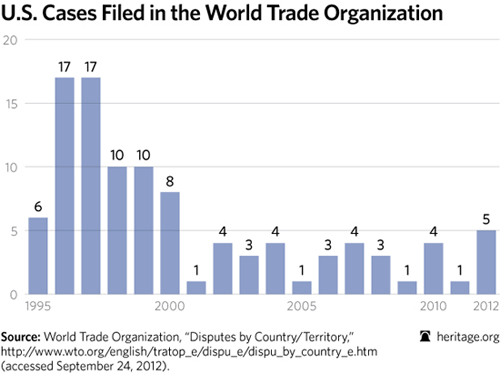
U.S. cases in the WTO decline - A statistic

This graphic shows the WTO cases filed by the U.S. at the Dispute Settlement Mechanism. A substantial decline in cases bright forth from the initial days of the WTO. 

Signs of more political compromise, less trade friction or just circumstances?


Hat tip to The Foundry for highlighting this here in a different context .


Wednesday, September 12, 2012

Trade war redefined

Increasingly, signs of "protectionist measures" are seen in trade policy across the world. Experts have attributed this to a rising protectionist wave that could severely challenge the multilateral system. With the Doha round in an impasse, policies that do raise barriers to trade cause tremendous friction between trading partners.

This friction is reflected in two kinds of action - first, a tit for tat protectionist measure which leads to more protectionism in the ecosystem and second, a tit for tat WTO litigation. While the former increases the chances of protectionism, the latter tends to ease the situation with a claim for bringing down the barriers.

Simon Lester has this succinct piece in the Cato blog where he discusses the "new kind of trade war" - litigation at the WTO. We have seen that recently in the context of Argentina.
"Complaints at the WTO do not always lead to a finding of violation of trade rules, of course.  The rules are complex and every case must be evaluated on its own merits.  But nevertheless, the notion that, in the current version of a trade war, challenges to trade restrictions will be met with challenges to other trade restrictions is a vast improvement over the old-style trade war.  With trade negotiations progressing so slowly these days, we should be happy if trade litigation can bring about some degree of liberalization. 
It is worth noting that there are potential pitfalls.  The WTO litigation system could be overwhelmed with cases; and in the search for cases to bring in response, countries might choose to file somewhat frivolous cases that might not otherwise have been brought.  But despite such concerns, a shift away from the old-style trade war is of great benefit to the world trading system and to the cause of free trade."
Whether the WTO can handle a floodgate of such requests is open to debate. It would test the capabilities of the "crown jewel" of the international trading system. However, the more pertinent issue is, how would countries deal with this deluge? It would call for enhancing legal capacity, cross sectoral analysis with multi-stakeholder teams and a national strategy to succeed at the WTO.


Friday, August 17, 2012

Compliance at the WTO - rule based or power based?

It is often emphasised that less developed countries, especially countries in Africa and some developing countries cannot actively engage in the DSU due to variety of factors including legal capacity, costs and lack of long term strategic planning.

Another issue that is central to the DSU is compliance. How do countries comply with decisions of the Panel and Appellate Bodies? What is the record of compliance at the WTO? Since it is a rule based system, not dependent on power diplomacy, do the records show that countries both developed and developing/less developed countries comply in a similar manner? What motivates compliance in international trade law? Is the fear of non-compliance strong enough to ensure compliance?

Petros Mavroidis in a brief note brings out the various challenges to compliance at the WTO. In his briefing paper titled "On Compliance in the WTO Enforcement Amongst Unequal Disputants" he tends to argue that the compliance record at the WTO is not very positive and developing countriea are at a disadvantaged position due to a variety of factors. The realities of trade and unequal trading relations influences compliance to a decision rather than the letter of the law per se.
"The intensity of inducement to comply is a function of the credibility of the threat: it is one thing for the EU to be excluded from the Ecuadorian market and yet quite another from Ecuador to be excluded from the EU market in terms of the impact on the Ecuadorian market. As noted before compliance can be induced on grounds unrelated to WTO because the  ‘big’ guys have more ‘persuasive’ power in that they have more weapons to use when they decide to retaliate which increases their retaliatory power as Bernheim and Whinston (1990) demonstrated in their study on enforcement under the competition law regime."
Thus a country which is has a much more diversified export portfolio and is a stronger trading power would be able to resist the threat of non-compliance than a smaller trading power. The reality of international business takes over rather than the power of the law. Compliance is viewed as another negotiating tool rather than a mandate of law.

Mavroidis makes an interesting point on the ability of developing countries to detect violations of WTO obligations by other countries.
WTO Members possess unequal capacities to detect deviations which is especially true because of the absence of centralised enforcement as present in the EU. Whilst the powerful nations may rely on a highly diversified export portfolio and the presence of trade diplomacy all around the world, the weaker nations are required to rely on the Trade Policy Review Mechanism (TPRM) which offers scattered information on a periodic basis and the notification system which is based on the incentives which support disclosure. Only the member countries which possess better detecting capabilities and more sophisticated administrations are in a better position to act quickly once they identify a deviation, quickly reducing the period of impunity for the deviators."
Thus, compliance depends on the bargaining asymmetries of the parties involved. the DSU is a forum where unequal trading powers are governed by "equal" trading rules. The record of compliance is an interesting aspect of international law, politics and trading relations. In the context of compliance in the Cloves Cigarettes case where the United States and Indonesia are involved, I had raised the issue of compliance here. One would have to go beyond the boundaries of a dispute and the decisions to unravel the motivations and ultimate decision to comply with a Panel or Appellate Body decision. This throws open questions of how "rule based" the system. Does it take us back to the power realities of international trade? Is compliance ultimately dependent on a country's trading power and influence rather than actual non-compliance of international law? If so, how true is to say that the rule based system overrides a power based system at the WTO?