Monday, August 6, 2012

Time for a Trade Facilitation Agreement to break the Doha impasse?

The Doha round impasse in multilateral trade negotiations and the possible way forward has been the subject matter of many scholarly articles, discussions and vociferous debates. I have blogged about some of them here, here and here. Should the "single undertaking" condition be waived to seize low hanging fruit and move the negotiations forward? Are there areas in which both the developed and developing world can see a common benefit and agree to disagree on the rest? The Doha Ministerial Declaration in 2001 which began the Doha round of negotiations was clear on the 'single undertaking" when it stated:

"With the exception of the improvements and clarifications of the Dispute Settlement Understanding, the conduct, conclusion and entry into force of the outcome of the negotiations shall be treated as parts of a single undertaking. However, agreements reached at an early stage may be implemented on a provisional or a definitive basis. Early agreements shall be taken into account in assessing the overall balance of the negotiations."
A Project Syndicate piece by Robert Zoellick, Ahmad M.Al-Madani, Donald Kaberuka, Haruhiko Kuroda, Thomas Mirow, Luis A Moreno titled "How to Make Trade Easier" highlights the need for an offensive by the WTO to clinch achievable missions to make international trade more attractive to both the developed and developing world. Arguing that efforts must be made to make "trade easier, they have canvassed for a new "Trade Facilitation Agreement" to benefit all trading countries. Offence, in trying times, is the best form of defence.
"The WTO’s best defense of open trade is a good offense. A new WTO Trade Facilitation Agreement would benefit all by increasing developing countries’ capacity to trade, strengthening the WTO’s development mandate, and boosting global economic growth. More than a decade after the launch of the Doha Round of global free-trade talks, this agreement could be a down payment on the commitment that WTO members have made to linking trade and development.
Comments
Developing countries stand to gain the most from improving trade facilitation. The right support would help traders in poorer countries to compete and integrate into global supply chains.
Comments
There are rich opportunities for gains. Inefficiencies in processing and clearing goods put traders in developing countries at a competitive disadvantage. Outdated and inefficient border procedures and inadequate infrastructure often mean high transaction costs, long delays, opportunities for corruption, and an additional 10-15% in the cost of getting goods to market – even more in landlocked countries."
Implying  that a Trade Facilitation Agreement is a non-controversial subject, benefitting all countries it can be agreed upon coupled with capacity building and technical assistance to countries who need to implement it. 
"In international negotiations, there is always a way forward if the benefits of an agreement are shared by all. Trade facilitation offers a development dividend for all countries. It is time for WTO members to make progress on issues where there is room to do so. It will be a down payment on a solid investment."
 Some observations:

1. Will countries be willing to give up the "single undertaking" principle so easily? Can there be other such non-controversial subjects in the basket of negotiating agendas that can be agreed and implemented? 

2. On a more skeptical note, does Trade facilitation impact developing countries and the developed world equally? It is seen that less developed countries and some developing countries have archaic trade procedures that impact both their exporters and importers. Trade Facilitation will help simplify non-transparent rules and procedures. Is this a way of increasing access of developing countries markets to the developed world? The developed world already has better trade procedures which may not be impacted by the Trade Facilitation Agreement.

3. One area where the Trade Facilitation Agreement will certainly help is capacity building and infrastructure support to improve trading and reducing transaction costs. If it helps a poor exporter from a developing country to access developed markets, the Trade Facilitation Agreement is a welcome relief. However, the impact should not be one sided - improving access to developing countries markets while the developed markets remain a distant reality.

4. What is stopping countries from agreeing on a Trade Facilitation Agreement if it benefits one and all? Is it only the single undertaking pitfall or is there something more?


Sunday, August 5, 2012

Reached 20K ... feels even better

The blog has reached 20,000 hits today. While it took 6 months for the first 10k, the second 10k took exactly half that time. This was unthinkable a year ago.


Feels humbling to know that the blog is read. Thank you all for the support, words of encouragement (both by comments and emails) and reading. Spurs me on...

Airbus-Boeing dispute - Not time yet for a political settlement?


(A 380)


News of Airbus setting up a plant in the U.S. was doing the rounds here. Does this make the chances of a political compromise less possible? I had blogged about the issue of a political compromise as one of the main ways of settling this long pending dispute. The details of the new development is:
"Airbus had initially offered to assemble some commercial freighters in Mobile to sweeten a bid for a bitterly fought $35 billion refueling tanker contest it lost to Boeing last year. 

The latest plan calls for a $600 million Alabama assembly plant dedicated to the A320 passenger jet that would start at four aircraft a month, one person familiar with the matter said. 

It would be the second plant outside Europe for Airbus's most popular jet. The EADS unit produces 37 planes a month between France and Germany and 3 a month in China. By the end of this year it plans to reach 38 in Europe and 4 in China."
The NYT reported about the development here:
" Airbus, the European airplane maker, announced Monday that it would invest $600 million over the next five years to build an assembly line here for its popular A320 single-aisle jet — its first factory in the United States.
The move into the heart of Boeing’s home market is part of a long-term strategy by Airbus aimed at doubling its share of the world’s largest market for 150-seat airplanes, which includes Boeing’s top-selling 737.
“This is the right move at the right time and in the right place for Airbus,” said Fabrice BrĂ©gier, the new chief executive of Airbus. “With this step, we will be the only genuine global player in the aerospace industry.”

Signs that this would not lead to an atmosphere conducive for a political settlement (in terms of Boeing creating American jobs after it's alleged subsidies affected them) was evident in Boeing's response:
Boeing, for its part, has dismissed claims by Airbus and Alabama officials of the plant’s economic impact, arguing that the numbers of new jobs that will be created “pale in comparison to the thousands of U.S. jobs destroyed by illegal subsidies” Airbus has received from European governments over the past three decades." 
Not time yet for an "out of court" settlement? Is the battle between the two aircraft giants going to intensify? Their opposition to the EU ETS was the only rallying point. Competition from China may be another in a few years. but for now, the battle seems to be getting more intense.


Saturday, August 4, 2012

Developing countries and compliance in WTO disputes - Some thoughts

Normally, one tends to focus on WTO disputes in terms of the issues they raise, developed -developing country relations as well as the political economy of the dispute. Seldom is detailed analysis done after the Panel or Appellate Body provide their decisions. What happens to compliance? How are the decisions implemented? What is the efficacy of the implementation of WTO disputes and what bearing does it have on implementation of international law? What special lessons does the study of compliance in WTO disputes have for developed-developing country dynamics at the WTO?

Sonia Rolland has a brilliant, detailed piece on development status of members at WTO disputes and what implications it has for implementation and compliance of the decision? Does it make it easier for developing countries to ensure compliance from developed countries? Does the WTO provide for such preferential treatment? Does one view developing countries more favourably as compared to a respondent developed country in terms of the need, speed and nature of compliance?

In her article "Considering Development in the Implementation of Panel and Appellate Body reports" Sonia Rolland makes a detailed analysis of Article 21 and 22 of the DSU and the impact it has for developing countries. Article 21 of the DSU, as suggested by the author has three specific clauses that pertains to a "development" preference:
"The Article includes three clauses regarding developing members: 

-Article 21.2 specifies that “[p]articular attention should be paid to matters affecting the interests of developing country Members with respect to measures which have been subject to dispute settlement”

- Article 21.7 provides that “[i]f the matter is one which has been raised by a developing country Member, the DSB shall consider what further action itmight take which would be appropriate to the circumstances” and

- Article 21.8 states that “[i]f the case is one brought by a developing country Member, in considering what appropriate action might be taken,the DSB shall take into account not only the trade coverage of measures complained of, but also their impact on the economy of developing country Members concerned.”
The article, however, after making a detailed analysis of Panel and Appellate Body decisions comes to the conclusion that "development" considerations are not paramount in deciding on implementation issues and though there are guiding principles in the provisions the Panels and Appellate Bodies have been rather "neutral" in their interpretation. Discussing the proposals of various developing countries during both the Uruguay and Doha rounds for a re-look at compliance of WTO decisions and developing country needs, the author raises pertinent questions about developing countries and their participation at DSM:
"The effect of the shift to a rule-based system is generally thought to have leveled the playing field for weaker members in terms of the accessibility of adjudication and their ability to win disputes. While it has been assumed that the reinforced procedures of the DSU would benefit developing country litigants, both the qualitative and quantitative data regarding developing country participation (and even more so the virtual absence of LDC participation as a main party in disputes)132 suggest a more complex story. With respect to implementation, the rule-based framework’s impact on developing members’ ability to gain compliance from more powerful members is equivocal. While some large developing members have been successful at obtaining compliance from powerful members (see Brazil’s success against the US in the Upland Cotton dispute), smaller developing members remain at a serious disadvantage. With some exceptions, such as Antigua in the Gambling dispute, weaker members have not often taken on more powerful members (developed or developing) in part because they realize that the retaliatory system of Article 22 may not be of much use to them.

Perhaps equally noteworthy is the virtual absence of developed country submissions on compliance procedures, both during the Uruguay Round and the Doha Round. Yet the reality of WTO disputes is that they have involved mostly developed countries–though the trend is rapidly shifting in favour of developed/developing country disputes and disputes between developing countries. In fact, trade asymmetries and the limitations they pose to effective retaliation affects small developed countries as well as developing countries.Submissions, however, generally propose to differentiate implementation recourses along the lines of the developed and developing members, rather than on macroeconomic criteria such as a ratio of the size of the economies of the country in disputes. Another approach would be to give all members access to the full range of implementation mechanisms (individual, third party and collective retaliation, for example) and to let the economic conditions of the disputants in specific cases determine which mechanism would be the most effective."
While the present report card of compliance and implementation issues vis a vis developing country concerns is not very positive, the author suggests a number of measures that could take into account the "development concern" during compliance:
"Nonetheless, a number of alternative avenues exist to reinforce the DSU’s effectiveness for developing countries with respect to compliance and retaliation, even in the absence of any textual reform. First, a more coherent and concerted practice by arbitrators, Panelists and the AB could lead to the emergence of new standards of interpretation. For instance, provisions urging members to “take into account” the developmental conditions of some members may be read as due diligence or best efforts obligations rather than be ignored altogether or treated as merely hortatory language. Second, decisions by the DSB, or WTO members acting as the General Council, could also be used to implement an interpretative framework that could be more cognizant of the needs of developing members. Third, increased resources and technical assistance could support both a shorter litigation calendar and faster compliance by developing country members. While trade asymmetries are certainly an economic problem hindering small developing countries from obtaining compliance from more powerful members, it is one that can be mitigated in part by legal and institutional intervention."
What should the theoretical framework be in the context of developing country disputes? Also "developing countries" is not a monolithic homogeneous unit. It has countries of varying trading power, influence and capacity. Also, I was trying to contextualize this article, albeit in a very preliminary manner, with recent decisions of the Panel and Appellate Body of the WTO. The Tuna case, Cloves Cigarettes case, COOL case as well as Export of raw material case all have developing countries pitted against developed countries. While the first three have U.S.as the developed country with Mexico, Indonesia and Mexico as respondents, the fourth case has China as the defendant and a developed country (United States) as the complainant. What thrust should the "developing" country context play in ensuring compliance by the respondents in this case? Compliance should increasingly reflect the rule based nature of the DSU rather than trading power or politico-economic realities of countries. Will we see innovative interpretations of "compliance" that would make the decisions ineffectual? Will the developing countries involved have the legal capacity to take on the developed country in establishing the right way of implementation? On a different note, is the developing country-developed country dichotomy irrelevant for compliance? Will we see some lessons for compliance in the way these decisions are complied  (or not complied?) with?


Friday, August 3, 2012

Of Rum and a WTO dispute


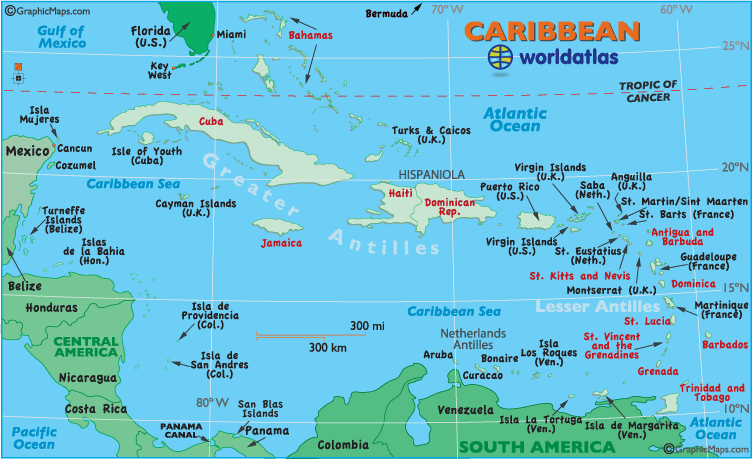
Rum and a WTO dispute? This looks plausible with the Caribbean countries raising the issue of "subsidization" of the rum industry in the U.S. The issue was widely reported here, here and here. The Caribbean countries are the 13 island countries in the Caribbean sea which includes Antigua, Dominican Republic and Haiti.


Caribbean Map, Caribbean Islands, Map of the Caribbean, West Indies Map

The Caribbean countries produce and export rum in large quantities to the U.S. and EU. The issue essentially pertains to the "cover-over" program wherein the U.S. provides refunds of excise tax collected on rum to the U.S. States producing it. A brief history of the cover-over program is provided by this Congress Research Service Report

Apart from the Caribbean countries, Puerto Rico (PR) and U.S. Virgin Islands (USVI) also produce rum which serves as competition to the rum produced in the Caribbean countries. The funds received by PR and USVI  in turn is being allegedly used to develop the rum industry and infrastructure in these U.S. States that adversely impacts rum producers in the non-US Caribbean countries. The  U.S. transfers 98% of the revenues collected on excise taxes imposed on rum sold in the US market to the Governments of Puerto Rico and the USVI. The programme does not provide any limitation as to how these two territories are to spend the transferred revenues. Until 2008, these funds were used for infrastructural development and welfare programmes by the Governments of the two territories. However, both territories are now said to be using some of these funds to finance activities aimed at the promotion and assistance of the local rum industry, to the detriment of rum producers established in these countries. 


The issue of the use of the funds for assisting the local rum industry has to be critically analyzed in the context of U.S. obligations under the ASCM Agreement. While use of the funds for general infrastructural development may be out of the purview of a WTO law  inconsistency, specific programs to promote and develop the rum industry may be suspect. Would it amount to a prohibited or actionable subsidy under ASCM? Would it violate the NT and MFN principles under GATT?

Cato explains the dispute lucidly here:
"The antagonist in this saga is something known as the “rum cover-over” program. As it does with all distilled spirits, the federal government charges an excise tax of $13.50 per proof gallon of rum sold in the United States. This equates to roughly $2 per bottle. Under the cover-over program, almost all of that money is directly granted to the U.S. Virgin Islands and the Commonwealth of Puerto Rico using a complex formula so that each receives a share of the money based on how much rum it produces relative to the other. The tax is collected from sales of all rum imported to the mainland, even from other countries, and in 2010 the cover-over amounted to approximately $450 million—$100 million to the Virgin Islands and $350 million to Puerto Rico. 
The industrial death spiral began when the government of the U.S. Virgin Islands cleverly discovered that, instead of using the money for infrastructure and welfare programs, it could use the bulk of the money to entice Captain Morgan producer Diageo to relocate there from Puerto Rico. Because the move will increase rum production in the U.S. Virgin Islands relative to Puerto Rico, the subsidy more than pays for itself by it helping the territory capture a larger share of cover-over funds."
Is the refund of excise taxes by the U.S. to PR and USVI and their subsequent use to promote the local rum industry in violation of U.S. obligations under the ASCM and GATT? The measures seem to have an adverse impact on the rum producers of other Caribbean countries and thus, as observers believe, amount to an actionable subsidy under WTO law. Will the Caribbean rum producing countries initiate a WTO dispute against the U.S.? Dominican republic, which has joined the Tobacco Plain Packaging dispute against Australia is likely to initiate this dispute against the U.S.

(Local Caribbean sugarcane growers)

The impact the U.S. measure has on local, small time producers of rum in the Caribbean countries is brought out by this commentary:
"While there is understanding of the economic problems facing the USVI, the reality is that the US Congress has allowed its USVI development program to divert hundreds of millions to primarily provide a development program for the largest distilled spirits companies in the world.  In this way the US is damaging one of the few competitive industries that Cariforum nations have and which helps underpin the economic viability of small and sometimes vulnerable Caribbean states.
... 
Rum has a special place in the hearts and minds of Caribbean people. It is a product that brings identity through small producers to the islands and countries of Cariforum from which it comes.  Unlike the product of large multinational distilling groups the success of Cariforum producers does not result from artificial tax breaks, transfer pricing or subsidy. Instead it is an industry dominated by small local distillers whose product is export oriented, brings much needed foreign exchange, adds value to primary agriculture and provides significant levels of tax and revenue to Governments struggling to deliver social programmes. 
That is why rum has always been a product worth fighting for, as Europe knows to its cost and the US is about to discover."
Will the Rum dispute go all the way to the WTO? 


Thursday, August 2, 2012

Next decade goes to Africa?

I have earlier blogged about Africa being the next hub of international trade and manufacturing, going the China way hereThese interviews provide an excellent overview of the Africa-China trade relationship where the conclusion is that China is accessing Africa mainly for its raw materials while it exports its finished consumer and manufactured goods to Africa. I have also blogged about Africa, in all its diversity, and its role in the multilateral trading system here and here.


An interesting opinion on whether Africa would be the next manufacturing hub of the world replacing China is found in CNN here.
"To be sure, Africa has a number of manufacturing advantages that it has yet to realize. Besides low labor costs and abundant resources, these include duty-free and quota-free access to U.S. and EU markets for light manufactures under the Africa Growth and Opportunity Act and the Cotonou Agreement.

Is this enough to offset Sub-Saharan Africa's generally low labor productivity relative to that of its Asian competitors?

Yes, if Africa can implement appropriate supportive policies to leverage its opportunities soon. This is the finding from a recent book by a team of World Bank economists. China dominates the global export market in light manufacturing, and its competitive edge far exceeds that of low income exporters that recently entered the global market.

But steeply rising costs of land, regulatory compliance, and especially labor in China's coastal export manufacturing centers have begun to erode the latter's cost advantage, a trend likely to accelerate in the coming years.

The ongoing redistribution of cost advantages in labor-intensive manufacturing presents an opportunity for Sub-Saharan Africa to start producing many light manufactures, enhance private investment and create millions of jobs."
The book referred to above titled "Light Manufacturing in Africa: Targeted Policies to enhance Private Investment and Create Jobs" gives an overview of the measures needed to be undertaken to overcome constraints in the African context and promote "light manufacturing" sector in order to boost growth and jobs.

Will African continent be the next big player in the globalisation game? Will it be able to use the multilateral trading system to pursue its developmental agenda? The diversity and interests of African countries are varied and complex. Clubbing them into one monolithic entity of the "African" interest may not be ideal in the context of international trade. After all international trade is largely guided by strong, national business interests and how a country interprets global trade rules to pursue one's agenda legitimately. Can the African countries build capacity and expertise to engage with the multilateral system?

I have come across two splendid blogs on the African perspective on international trade. One is by Lynette Gytonga and the other by Henri Joel Nkuepo. Will the next decade be Africa's decade?

Wednesday, August 1, 2012

Antidumping - good, bad or ugly?


Anti-dumping duties are a common tool used by both developed and developing countries to protect local industry from a surge in cheap imports. It is viewed as an inevitable policy choice in a free trade environment when countries tend to  protect their industries. What motivates the imposition of anti-dumping duties? Is it a protectionist weapon in the hands of countries that undermines free trade with reduced barriers? Should it be discouraged? Is it a word in the WTO lexicon that needs to be gradually shunned? Or is it a legitimate domestic policy choice for countries to protect their local industries from unfair imports? This post does not go into the rationale of antidumping or the relevant rules but discusses two commentaries on the use and misuse of antidumping in international trade.

Mark Wu argued in his detailed piece "Antidumping in Asia's Emerging Giants" that this tool will be increasingly used by China and India in the coming years.
"Scholars and policymakers have assumed that India and China’s recent rising use is a fleeting anomaly, triggered by historic tariff cuts and a need to retaliate against other countries that are targeting them. In fact, this is not fully correct. Many industries in India and China have yet to discover the utility of antidumping laws. China has not yet fully embraced a strategy of using antidumping sanctions as a retaliatory instrument. And retaliation does not explain why India continues to use antidumping sanctions aggressively, even after others have ratcheted down their use of antidumping sanctions against India. These signs suggest that India and China’s use of antidumping sanctions as a protectionist instrument will not level off in the years to come. Instead, as their domestic markets grow, American and European exporters will likely incur larger costs from antidumping duties imposed by India and China."
Mark Wu essentially argued that the rules of antidumping need to be reformed with the U.S. and E.U. at the forefront so that it is not misused as a tool of "protectionism"' by developing economies. I had blogged about this article here with some questions.

More recently, Vox carried an interesting piece titled "Antidumping as cooperation" where two economists Chad P Bown and Meredith Crowley have argued that antidumping need not necessarily viewed negatively. They argue that it is sometimes a necessary component of a free trade regime which ensures imposition of a tariff above a county's bound rates. They aver that the underlying motivations for the use of the measure needs to be fully understood in order to strategize a stand at the WTO with respect to the antidumping rules. They conclude that understanding the motivations of the use of these measures will ensure that necessary rules can be crafted to ensure that the limits of these rules can be set properly set.
" If future research shows that trade volume shocks in sectors with relatively inelastic import demand and export supply are an important determinant of antidumping use for a large set of countries, the current WTO rules – which are not written so as to be sympathetic to economic logic – might be re-examined. Recognition that unexpected events in the turbulent global economy trigger tariff hikes might result in a more informed set of negotiations over what constitutes an appropriate versus inappropriate use of the exceptions to the liberal trade policy rules of the WTO. This could better inform the discussion about potential limits and boundaries to cooperation in the WTO system."
The multilateral trading system often faces the uncomfortable questions of impinging upon the sovereignty of national policy space. Critics in developing countries argue that it restricts domestic policy choices to protect legitimate national interest. Antidumping is an exception which provides this flexibility within trade rules to protect one's domestic interests. It is like a safety valve that can be used effectively within the contours of the multilateral agreement. To shun it would be to legitimize that view that multilateral rules do in effect restrict policy space. Developing countries are increasingly using the tool to protect their local industries. Whether the imposition is in consonance with multilateral trade rules depends on the facts and circumstances of each instance. An improper use of antidumping duties can be challenged at the DSM of the WTO. There is a need to balance the legitimate use antidumping has in world trade with the dangers of it's misuse. The above study probably would provide some answers to tread that line.